
What Is Cybersecurity? (Then and Now)
Cybersecurity is the discipline of protecting systems, networks, and digital data from unauthorized access, damage, theft, and disruption. At its core, it blends technical safeguards with human awareness, compliance policies, and ethical practice.
Since the early days of the internet, cybersecurity has evolved from basic antivirus and firewalls to sophisticated ecosystems defending against fast-moving threats across digital supply chains. In the 1990s, viruses like Melissa caused significant damage and sparked industry-wide interest in standalone security products, marking the birth of cybersecurity as a professional field. The last decade accelerated this evolution. Cloud adoption, remote work, and the proliferation of connected devices have significantly expanded the digital attack surface. In 2026, cybersecurity will have progressed well beyond defensive posturing to become an all-encompassing enabler of digital trust, economic continuity, and national security.
Key Takeaway: Cybersecurity initially focused on reactive protection but has evolved into proactive risk mitigation, requiring the anticipation of threats before they occur.
The Current Cybersecurity Landscape
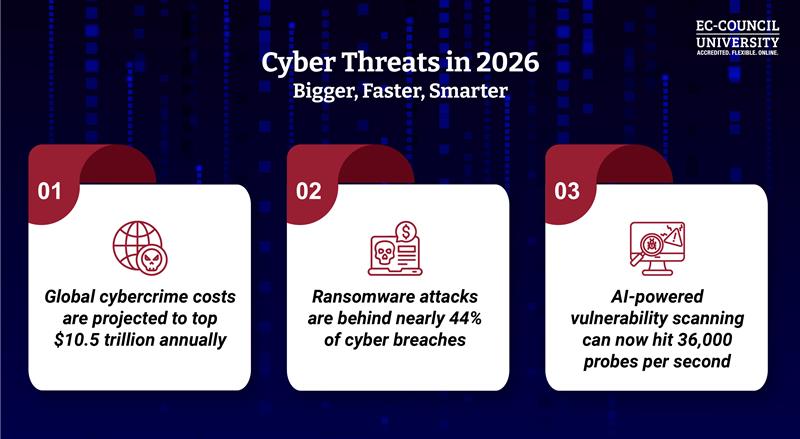
Cyber Threats Are Bigger, Faster, and Smarter
- Global cybercrime costs are projected to top $10.5 trillion annually in recent estimates, dwarfing the GDP of many nations. (Source: DeepStrike)
- Ransomware attacks now appear in as much as 44% of breaches, up sharply year-over-year. (Source: DeepStrike)
- AI-powered scanning operations can now hit 36,000 probes per second, enabling attackers to automate the discovery of vulnerabilities. (Source: TechRadar)
Threats aren’t limited to technology alone. Human error is responsible for 95% of security incidents, ranging from misdirected emails to poor password hygiene.
A Distributed and Complex Digital Ecosystem
Risks now span hybrid cloud infrastructure, software supply chains, IoT ecosystems, and AI-driven phishing campaigns. Centralization around a few major providers (e.g., AWS, Google Workspace, Microsoft 365) has created an “internet monoculture,” where breaches can quickly cascade.
Key Takeaway: Modern threats leverage automation, AI, and systemic dependencies, which make traditional perimeter defenses insufficient.
Cybersecurity Essentials in 2026
What Every Organization Must Implement
- Zero Trust Architecture: Nearly 86% of organizations have adopted zero-trust models, eliminating implicit trust in users and devices. (Source: CyVent)
- AI-Enhanced Security: Over 73% of enterprise SOCs now utilize AI for threat detection, boosting defensive effectiveness. (Source: ACSMI)
- Continuous Exposure Management: Platforms that simulate attack paths and prioritize remediation reduce breach likelihood significantly. (Source: Wikipedia)
What the Cybersecurity Profession Looks Like Today
- Security Operations Centers (SOCs) enable real-time monitoring and incident response.
- Managed Security Service Providers (MSSPs) are scaling protection for SMBs lacking internal expertise.
- Threat intelligence, red teaming, and ethical hacking now inform proactive defense.
Key Takeaway: Cybersecurity is no longer just a matter of technical know-how. It’s an amalgamation of technical competencies, strategic planning, risk management, and continuous vigilance.
Top Cybersecurity Tools, Technologies, and Practices in 2026
Modern defenses combine automation, analytics, and coordination:
- SIEM (Security Information and Event Management): Platforms like Splunk and IBM QRadar aggregate logs for real-time threat analysis.
- XDR (Extended Detection & Response): Solutions from Microsoft Defender XDR unify endpoint, network, and cloud telemetry into automated responses.
- SOAR (Security Orchestration, Automation & Response): Tools like Palo Alto Networks Cortex XSOAR empower security teams to automate workflows and reduce response times.
- Identity and Access Management (IAM): With the IAM market projected to surpass $24 billion, strong identity verification and MFA are indispensable.
- Threat Intelligence and Hunting: Active threat hunting, illustrated by advanced visualization frameworks, helps identify stealthy adversarial activities.
Key Takeaway: Organizations that integrate analytics, automation, and identity practices into cohesive defenses are far better positioned to detect and respond to modern threats.
Find out more about the top cybersecurity tools to use in 2026.
Main Cybersecurity Challenges in 2026
Here’s an overview of the most pervasive cybersecurity challenges over the next 12 months:
- Artificial Intelligence: AI is accelerating attackers’ capacity to craft convincing phishing, synthetic personas, and automated exploits. Meanwhile, defenders are relying on AI to triage alerts and predict threat patterns. (Get more insights)
- Talent Shortage and Skill Gaps: Despite spending increases, the global cybersecurity workforce still faces a significant shortage, threatening organizations’ ability to sustain robust defenses.
- Tool Sprawl and Integration Issues: Organizations manage an average of 83 cybersecurity tools across dozens of vendors, a complexity that ironically creates new security gaps.
- Supply Chain and Critical Infrastructure Risks: Third-party breaches and operational technology (OT) vulnerabilities continue to make supply chains a prime target for sophisticated attacks.
Key Takeaway: The expanding scale and sophistication of threats require adaptive responses — not static, siloed tools.
Core Skills Cybersecurity Professionals Must Possess in 2026
To thrive in this dynamic field, professionals must cultivate:
- Technical Foundation: Networking, cryptography, endpoint security, cloud security.
- AI and Data Literacy: Understanding how AI both defends and attacks.
- Threat Intelligence Acumen: Ability to analyze and anticipate attacks.
- Incident Response Skills: Coordinated detection and remediation capabilities.
- Communication and Risk Management: Translating security posture into executive insights.
Important to Note: Soft skills, such as strategic thinking and teamwork, are just as vital as technical mastery.
Why Cybersecurity Matters More Than Ever
Cybersecurity impacts more than corporate balance sheets. It affects national security, economic stability, and individual privacy. A major breach can disrupt critical infrastructure, erode trust, and lead to billions of dollars in financial losses. As digital transformation accelerates, cybersecurity shifts from being merely a safeguard to a societal necessity.
Cybersecurity Education: A Strategic Imperative
Why Cybersecurity Education is Essential
- Formal programs build foundational knowledge and real-world expertise.
- Cybersecurity certifications (like CEH, CND, and CHFI) validate hands-on skills.
- Degrees in cybersecurity prepare professionals with a deep strategic understanding.
EC-Council University: Empowering Future Protectors
Cybersecurity education isn’t just about learning theoretical concepts. It’s about developing adaptable and innovative professionals who can navigate an ever-shifting landscape. As a leader in cybersecurity education that combines academic rigor with practical relevance, EC-Council University equips students with globally recognized certifications and degree pathways that address real-world challenges. Our curriculum bridges theory with practice, helping individuals succeed in the demanding field of cybersecurity.
The Evolving Fundamentals of Cybersecurity
To recap, the fundamentals of cybersecurity have transitioned from perimeter hardening to resilient, intelligence-driven defenses that leverage AI, secure identities, and real-time analytics. As managing cyber risk becomes integral to business and national strategy, professionals must continually upskill to remain effective and competitive. EC-Council University’s cybersecurity degrees and certifications equip learners with the advanced knowledge, hands-on skills, and confidence to adapt and thrive in this digital age.
For more information on studying at EC-Council University:
Frequently Asked Questions About Cybersecurity Fundamentals
Fintech platforms handle sensitive financial data and transactions. Cybersecurity protects against breaches, fraud, and financial loss, safeguarding customer trust and regulatory compliance.
It protects digital assets, ensures business continuity, preserves trust, and defends national infrastructure against escalating threats.
Security analysts, ethical hackers, incident responders, cloud security architects, and threat intelligence specialists are highly sought after across multiple industrial sectors.
No. AI enhances detection and automation, but humans remain essential for context, strategy, and judgment.
Important cybersecurity tools in 2026 include SIEM (Splunk), XDR (Microsoft Defender), SOAR (Cortex XSOAR), IAM systems, and threat intelligence platforms.
Absolutely! Formal cybersecurity education and qualifications accelerate skill development, enhance professional credibility, and facilitate career growth.
Certifications validate specific skills, while cybersecurity degrees provide a far broader foundation of practical knowledge, technical expertise, and leadership acumen.
Expect greater automation, quantum-resilient cryptography, deeper integration of cybersecurity into development lifecycles, and continued emphasis on industry-aligned education.