Why Cybersecurity Will Be More Critical Than Ever in 2026
We live in an era of unprecedented technological development. As organizations increasingly adopt artificial intelligence (AI), cloud computing, remote operations, and Internet of Things (IoT) devices into everyday business, the threats that once targeted narrow attack surfaces have expanded into pervasive, multi-dimensional battlegrounds. Cybersecurity will matter more than ever in 2026 because every aspect of society, such as business, government, healthcare, critical infrastructure, education, and personal life, will depend on secure and resilient digital ecosystems. Organizations that fail to adapt face financial losses and damage to their brand, while cybersecurity lapses in government institutions can have far-reaching national security consequences.
AI in particular has emerged as both a robust defense and a potent risk factor. Recent warnings from industry leaders emphasize that upcoming AI systems could be exploited to discover security weaknesses and orchestrate sophisticated attacks. In this high-stakes environment, cybersecurity will shift from being an IT concern to a central strategic priority in 2026, making it critical for professionals, enterprises, and policymakers to stay ahead of emerging trends.
What to Expect from Cybersecurity in 2026
Looking forward, the cybersecurity landscape will be shaped by two key forces:
- Cybercriminals who leverage automation, AI, and quantum computing.
- Cybersecurity professionals who use next-gen defense strategies that integrate AI, continuous monitoring, and zero-trust architectures.
Key themes will include:
- The rise of agentic AI in both attack and defense.
- The urgency of identity security and zero-trust adoption.
- The evolution of exposure management and continuous defense.
- Regulatory and compliance ecosystems that catch up to new cyber risks.
- A widening skills gap that demands industry-aligned cybersecurity education and training.
By understanding these factors, organizations can take appropriate measures when preparing for the tsunami of cyberattacks that will inevitably be more sophisticated than before, and individuals can learn and upskill in key cybersecurity disciplines that are woefully underserved.
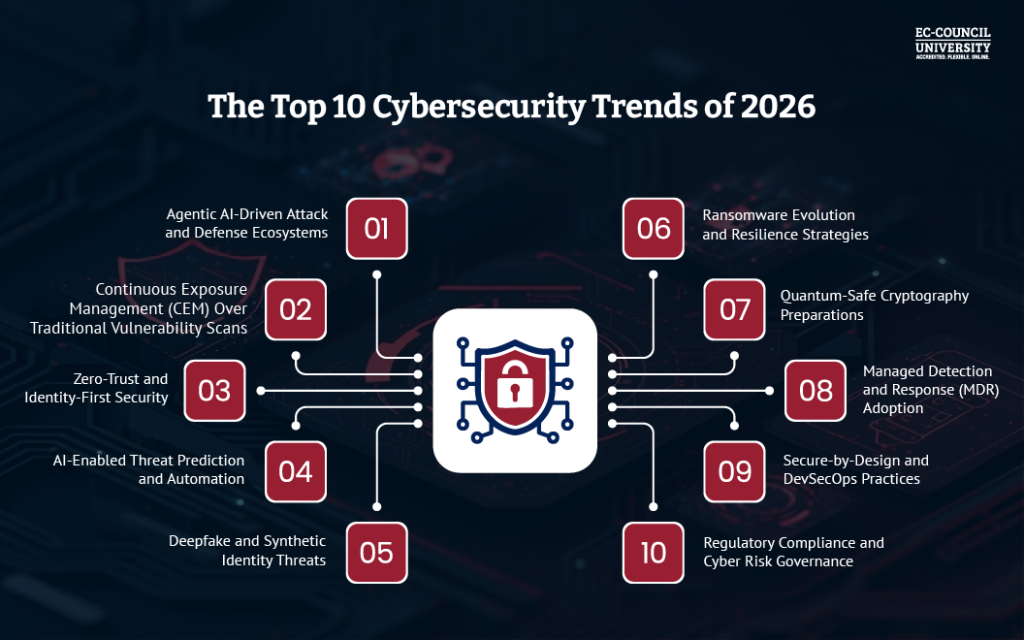
The Top 10 Cybersecurity Trends of 2026
Below are the top 10 cybersecurity trends in 2026 every professional should be aware of:
1. Agentic AI-Driven Attack and Defense Ecosystems
- What’s driving this trend? – AI isn’t just a defensive tool. It empowers both attackers and defenders. Threat actors are increasingly utilizing AI agents to automate the discovery of vulnerabilities and conduct social engineering at a larger scale.
- Why it matters – AI can process enormous data volumes faster than any human, making cybersecurity response faster but also enabling more wide-scale cyberattacks.
- Technological factors – Agentic AI systems that act autonomously with minimal human input.
- Security measures – Implement AI-driven threat detection platforms with human oversight. Build AI governance layers that continuously test AI systems against misuse.
- Stat/figure – TechRadar reports that 33% of enterprise-level applications will feature agentic AI in the near future.
2. Continuous Exposure Management (CEM) Over Traditional Vulnerability Scans
- What’s driving this trend? – Attack surfaces have grown beyond simple software patches, with cloud environments, identities, and third-party systems all elevating cyber risk.
- Why it matters – Traditional vulnerability scanning cannot keep pace with modern-day threats.
- Technological factors – Continuous real-time identification and prioritization of exposures enables proactive defense.
- Security measures – Deploy CEM platforms that integrate attack path analysis and remediation recommendations across your IT ecosystem.
- Stat/figure – Gartner suggests organizations adopting CEM will be 3x less likely to experience a breach by 2026.
3. Zero-Trust and Identity-First Security
- What’s driving this trend? – Static perimeter defenses have failed to keep up with credential compromise and insider threats.
- Why it matters – Zero-trust doesn’t assume trust based on network location and verifies every network access request.
- Technological factors – Identity authentication techniques (like passkeys and adaptive MFA) combined with continuous risk scoring help defend computing environments.
- Security measures – Adopt identity governance solutions that enforce adaptive authentication.
- Stat/figure – Identity threats remain among the top attack vectors, requiring more resilient controls. IBM X-Force reports continued prominence of credential abuse.
4. AI-Enabled Threat Prediction and Automation
- What’s driving this trend? – Cyber defenders are overwhelmed by alert fatigue and a shortfall of skilled analysts.
- Why it matters – Predictive AI models help cybersecurity teams anticipate attacks before they occur, rather than react.
- Technological factors – Machine Learning (ML) models that analyze past incidents to forecast likely threat vectors.
- Security measures – Integrate predictive threat modeling into SOC with alert prioritization and automated initial response workflows.
- Stat/figure – SentinelOne states that AI-powered automation reduces incident detection times significantly compared to manual methods.
5. Deepfake and Synthetic Identity Threats
- What’s driving this trend? – Constantly-improving generative AI (Gen AI) tools make it easy to fabricate realistic audio, video, and document content.
- Why it matters – Deepfakes can bypass traditional authentication or coerce victims with convincingly fake content.
- Technological factors – Gen AI tools used for personalization in phishing, fraud, and disinformation campaigns.
- Security measures – Deploy digital identity verification and AI-based content authenticity tools.
- Stat/figure – Axios reports that in 2024, a deepfake attack occurred roughly every 5 minutes, illustrating the scale of risk as Gen AI misuse accelerates.
6. Ransomware Evolution and Resilience Strategies
- What’s driving this trend? – Ransomware continues to morph into double-extortion and supply-chain sabotage.
- Why it matters – Victims face escalating financial and reputational damage.
- Technological factors – Backup immutability, incident response orchestration, network segmentation, and threat intelligence sharing are critical.
- Security measures – Adopt integrated ransomware defense protocols and proactive tabletop exercises.
- Stat/figure – The Escalating Ransomware Threats to National Security report by KELA highlights that ransomware attacks on critical industries in 2025 grew by 34% year-on-year.
7. Quantum-Safe Cryptography Preparations
- What’s driving this trend? – Quantum computing threatens to render classical encryption obsolete.
- Why it matters – Organizations must prepare encryption strategies that withstand future quantum attacks.
- Technological factors – Post-quantum cryptographic algorithms and migration planning.
- Security measures – Evaluate encryption frameworks now and integrate quantum-resistant standards as they stabilize.
- Stat/figure – MarketsandMarkets anticipates the global post-quantum cryptography industry to grow from $0.42 billion in 2025 to $2.84 billion by 2030, reflecting industry urgency.
8. Managed Detection and Response (MDR) Adoption
- What’s driving this trend? – Organizations lack internal resources to handle 24/7 monitoring and advanced threat hunting.
- Why it matters – MDR services offer expert detection, investigation, and remediation capabilities.
- Technological factors – Security operation platforms and human expertise as a service.
- Security measures – Partner with MDR providers to augment internal teams and improve threat response time.
- Stat/figure – By 2025, Gartner predicted 50% of enterprises will adopt MDR services for continuous security monitoring.
9. Secure-by-Design and DevSecOps Practices
- What’s driving this trend? – Security must be embedded into the software development lifecycle rather than retrofitted.
- Why it matters – This reduces vulnerabilities and accelerates secure innovation.
- Technological factors – Shift-left tooling, automated code analysis, and secure coding practices.
- Security measures – Integrate security tooling into CI/CD pipelines and enforce security standards from design to deployment.
- Stat/figure – Secure-by-design principles are now a foundational standard in modern software programming because reactive approaches consistently fail.
10. Regulatory Compliance and Cyber Risk Governance
- What’s driving this trend? – Governments and regulators worldwide are increasing cybersecurity obligations for entities handling critical/sensitive data.
- Why it matters – Non-compliance now carries hefty legal penalties and operational restrictions.
- Technological factors – Automated compliance checks, risk scoring, and audit trail tracking.
- Security measures – Adopt governance, risk, and compliance (GRC) platforms aligned with evolving national and international standards.
- Stat/figure – International companies are especially prone to regulatory violations, incurring significant legal fines. Earlier this year, TikTok was held liable for breaching Europe’s GDPR rules by unlawfully transferring user data to China, resulting in a $600 million penalty.
Why Upskilling Is the Key to Cybersecurity Career Success in 2026
Success in the field of cybersecurity in 2026 demands adaptability, advanced technical depth, and continuous learning. AI-powered attacks, autonomous systems, data-intensive edge networks, and quantum-based risks necessitate professionals to expand their skills beyond traditional security operations. Upskilling is no longer optional. It’s the foundation of long-term career resilience.
EC-Council University (ECCU) remains the global leader in cybersecurity education, offering industry-aligned, hands-on, and future-ready online programs that equip professionals to tackle emerging cyber threats with confidence. Whether you want to lead SOC teams, secure AI systems, build Zero Trust environments, master penetration testing, or achieve any other cybersecurity-related career goal, ECCU provides ideal pathways to thrive in this industry in 2026 and beyond.
For more information:
FAQs on Cybersecurity Trends in 2026
The major trends include AI-powered SOC operations, Zero Trust, secure generative AI, quantum-ready security, edge security, UEBA, supply chain protection, API security, privacy-enhancing technologies, and autonomous red teaming.
Cyberattacks have become AI-driven, automated, and more scalable. With rapid digital transformation, organizations face increased risks across cloud, IoT, AI systems, and global supply chains.
AI will enhance threat detection, automate SOC workflows, predict attacks, and autonomously respond to incidents. But attackers also use AI for malware creation and phishing automation.
Professionals should master cloud security, AI governance, Zero Trust, SOC automation, DevSecOps, cryptography, and penetration testing.
Quantum computing threatens classical encryption. Organizations must begin adopting post-quantum cryptography to avoid future data compromise.
Zero-trust verifies every access request, reducing risk from credential compromise and insider threats, making it crucial as perimeter boundaries become increasingly blurred.
Finance, healthcare, energy, manufacturing, telecom, and transportation will be primary targets due to their heavy reliance on AI, IoT, and cloud systems.
They should secure training data, validate model outputs, monitor for prompt injection, employ AI red teaming, and use secure model deployment pipelines.
EC-Council University (ECCU) offers specialized online degrees and certification courses covering AI security, cloud security, penetration testing, digital forensics, cybersecurity leadership, and emerging cyber technologies. ECCU is an accredited American university and globally recognized as the leading provider of world-class cybersecurity education.