Why Cybercriminals Target Online Learning Platforms
The growth of online learning has transformed education. Platforms that deliver virtual courses, hybrid instruction, and digital collaboration tools now serve millions of students and faculty worldwide. But this rise is accompanied by a stark reality: online learning platforms are high-value targets for cybercriminals. Take the Indian education sector as a notable example. In 2025, online education providers in the country experienced about 8,487 weekly cyberattacks. Malicious actors are drawn to the enormous volumes of sensitive information they host, which include personal data, financial records, proprietary research, and intellectual property.
In such a hazardous environment, cybersecurity is not a luxury. It’s foundational to operational integrity and maintaining trust in digital education. Without robust defenses, institutions risk financial loss, reputational damage, interrupted learning, and far-reaching legal consequences.
The Expanding Attack Surface in Online Education
Online learning platforms are inherently complex ecosystems. They connect students, faculty, administrators, and third-party services across cloud infrastructures, personal devices, and Learning Management Systems (LMS). Each touchpoint expands the attack surface, which is the sum of all possible entry points for cyberattacks. The threat factor multiplies as platforms integrate more collaboration tools, mobile apps, video conferencing, cloud storage, and exam proctoring software. Many institutions struggle to maintain consistent security controls across this diverse infrastructure, presenting attackers with abundant vulnerabilities to exploit.
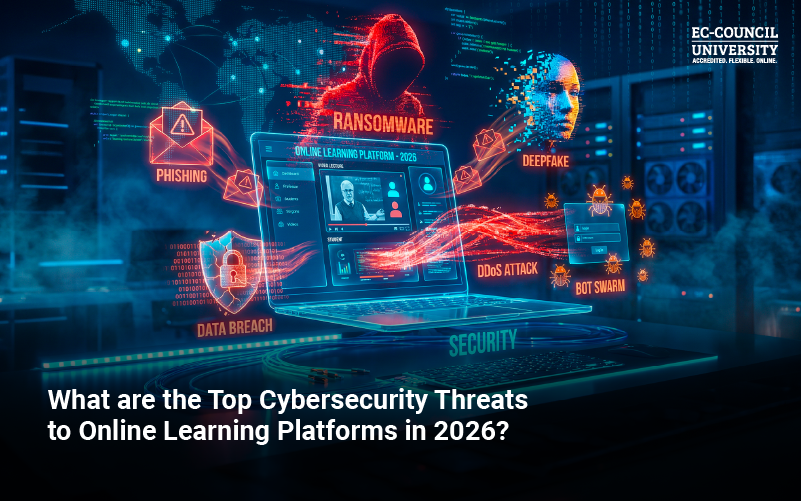
Let’s examine the top cybersecurity threats faced by online learning platforms in 2026:
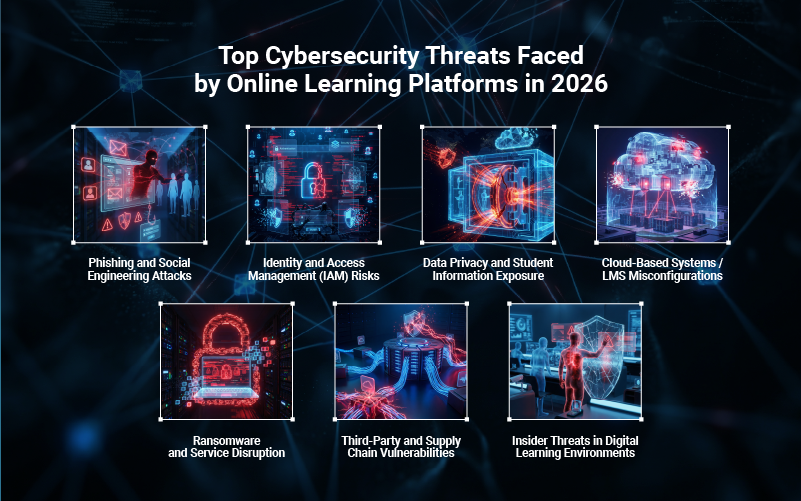
1. Phishing and Social Engineering Attacks
Phishing is one of the most pervasive cybersecurity threats in online education, and it’s only getting worse as AI-powered campaigns become more effective. Whether delivered via email, chat apps, or SMS, social engineering campaigns continue to dupe students and faculty into divulging credentials or clicking malicious links. Globally, phishing remains among the top vectors for harvesting login information. Email-based scams account for the majority of successful breach methods, often leading to compromised credentials reused across systems.
Attackers are increasingly using personalized messages, AI-generated content, and highly targeted campaigns to trick users. These tactics are particularly effective in environments with limited security awareness training (a common gap in many academic institutions).
2. Identity and Access Management (IAM) Risks
Identity and Access Management (IAM) vulnerabilities rank among the top attack enablers in the online education sector today. According to recent security research, a large majority (around 86%) of web application breaches in education began with compromised credentials. Weak or reused passwords, inadequate deprovisioning of former users, and a lack of multi-factor authentication (MFA) create easy entry points for attackers. Students often use the same credentials for personal and institutional accounts, thereby widening the risk.
Modern IAM controls, such as single sign-on (SSO), context-aware authentication, and automated privilege management, are essential to reduce exposure.
3. Data Privacy and Student Information Exposure
Online learning platforms collect mountains of personal and academic information, such as full names, addresses, educational records, financial information, and even biometric data in some proctoring systems. When this data is mishandled, stored insecurely, or exposed through breaches, the implications are dire and long-lasting. For example, a recent ransomware incident at a multinational education provider exposed the personal data of thousands of children and staff, posing harmful privacy risks.
Beyond outright breaches, concerns about intrusive data collection by third-party educational apps also raise privacy red flags. Additionally, some classroom tools collect extensive behavioral and location data, creating serious compliance and ethical questions.
4. Cloud-Based Systems / LMS Misconfigurations
Cloud environments are the backbone of modern online learning services. But misconfigurations, such as improperly secured storage buckets, excessive user permissions, and unsecured APIs, remain rampant. Data shows that tens of thousands of cloud assets and web applications remain exposed due to configuration errors, leaving sensitive information accessible to even semi-skilled cybercriminals.
Unchecked misconfigurations can lead to data leaks, unauthorized access, and service disruptions, all without the need for sophisticated attack techniques.
5. Ransomware and Service Disruption
Ransomware attacks against educational institutions continue to escalate, crippling systems and disabling access to critical data. In some regions, ransomware incidents in online education spiked by double-digit percentages year over year, with average ransom demands surpassing six figures. Even when institutions resist paying ransoms, recovery is expensive and disruptive. Class cancellations, operational paralysis, and damaged reputation are common fallouts.
The impact of ransomware extends beyond cost. It undermines trust in digital education infrastructure at scale.
6. Third-Party and Supply Chain Vulnerabilities
Educational institutions rarely operate in isolation. They extend their infrastructure through third-party services, vendors, and EdTech applications. Each integration expands the potential for supply chain attacks. Inadequate vendor security assessments, poor encryption practices, and unchecked access rights can turn trusted partners into attack vectors. Recent breaches have shown that even central cloud file-transfer platforms can provide attackers with footholds when vulnerabilities go unpatched.
Robust third-party risk management and continuous monitoring are vital defenses in this regard.
7. Insider Threats in Digital Learning Environments
Threats aren’t always external. The education sector grapples with insiders (students, faculty, IT staff, or even contractors) who, intentionally or accidentally, can misuse access privileges. Whether it’s a disgruntled employee downloading sensitive files or a student misconfiguring software that exposes data, insider risk poses a significant blind spot.
Strong monitoring, privileged access restrictions, and robust role-based controls help mitigate this threat category.
Strengthening the Cybersecurity Posture of Online Learning Providers
Defending online learning platforms demands more than point products. It requires a holistic cybersecurity culture ingrained in every facet of digital operations. Here’s how online education providers can strengthen their cybersecurity posture:
- Security Awareness and Training for Users: Continuous, targeted cybersecurity awareness programs reduce the likelihood of successful phishing and credential exploitation. Behavioral training tailored to students and staff, backed by real-world simulations, measurably reduces human risk factors. Academic research shows that sustained security training can halve a user’s susceptibility to phishing within six months, proving that education itself is a vital defense.
- Strong IAM, Monitoring, and Incident Response Planning: Institutions must deploy advanced IAM solutions, enforce MFA, and promptly revoke unused accounts. Continuous monitoring and incident response playbooks ensure that breaches are detected and contained early, minimizing damage.
- Security by Design in Digital Learning Platforms: Cybersecurity mechanisms must be built into online learning platforms from inception. Secure coding practices, regular penetration tests, automated vulnerability scans, and configuration hardening are essential.
How EC-Council University Approaches Cybersecurity in Online Education
As leaders in cybersecurity education, EC-Council University (ECCU) prioritizes security-first delivery across our online platforms. We apply the latest industry frameworks such as NIST CSF and ISO 27001, perform continuous security monitoring and evaluations, and partner with academic and industry leaders to adopt best practices for platform security.
Importantly, we prepare current and future cybersecurity professionals to protect digital ecosystems through industry-aligned online degrees and certification courses, hands-on virtual labs, and career pathways in cloud security, penetration testing, digital forensics, secure programming, risk management, and other essential cybersecurity disciplines.
If you’re interested in pursuing world-class cybersecurity education to elevate or launch your career, you can:
Commonly Asked Questions About Cybersecurity Threats in Online Learning
They house large volumes of personal, financial, and academic data and offer multiple entry points across cloud, LMS, and collaborative tools.
Phishing remains one of the top attack vectors, with a significant portion of breaches rooted in credential theft.
No. Multi-factor authentication (MFA), proper IAM controls, and monitoring are essential to counter credential compromise.
No, both face threats. Smaller institutions often lack security resources, which increases their vulnerability.
Cloud misconfigurations are a frequent cause of data exposure, making secure setup and audits critical.
Regular backups, segmentation, and incident response plans reduce impact and recovery time.
If poorly vetted, these can introduce vulnerabilities across the institution’s infrastructure.
Human error remains a top risk, and training reduces phishing success rates and credential misuse.