Cybersecurity in Robotics is Not Optional
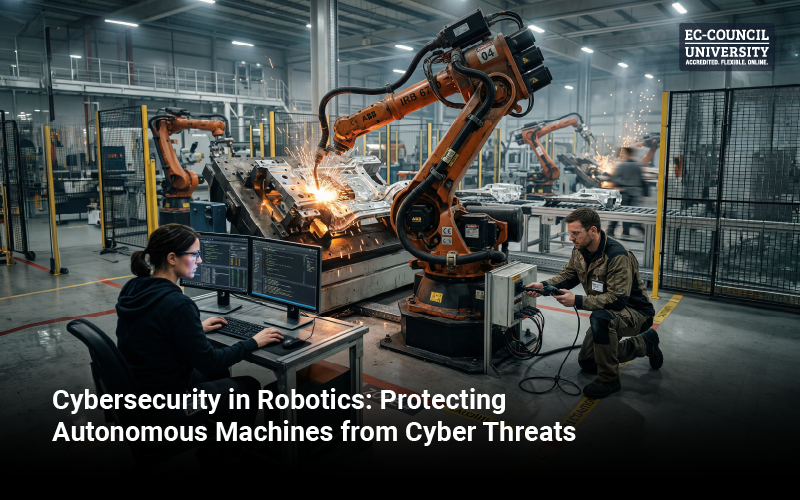
From isolated mechanical systems to highly connected, intelligent platforms that power industrial operations at scale, the field of robotics has certainly come a long way. Modern-day robots have evolved beyond simple functions into machines that communicate, learn, and make real-time decisions without human intervention. While this transformation has created immense business and societal value, it has also heralded a dangerous new reality. Robots are now prime targets for cyberattacks.
Manufacturing, for example, accounted for 25.7% of all cyberattacks in 2023, making it the most targeted sector. This was largely due to increased integration between IT and operational technology (OT) systems. When robots are digitally connected, they are exposed. And when they are exposed, they must be secured.
Once Just Machines, Now Cyber-Physical Systems
Robots are now considered cyber-physical systems rather than standalone devices. Cyber-physical systems are a fusion of hardware, software, networks, and AI.
These days, a typical robotic system includes:
- Sensors collecting environmental data
- Actuators executing physical actions
- Controllers running software logic
- Communication layers connecting to cloud and edge systems
Each of these layers introduces potential vulnerabilities. However, organizations still treat robots as individual mechanical assets rather than as networked computing systems with physical consequences.
Top 10 Cybersecurity Threats in Robotics
The threat landscape in robotics is both familiar and uniquely dangerous. The top 10 attack vectors include:
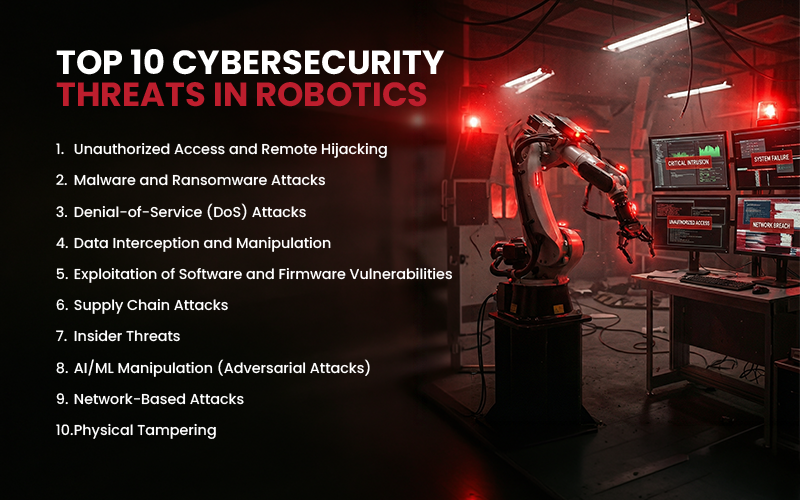
- Unauthorized Access and Remote Hijacking: Attackers gain control of a robot by exploiting weak authentication or exposed interfaces. In doing so, they can take control of industrial robots or drones, override commands or alter behavior, and disable safety mechanisms.
- Malware and Ransomware Attacks: Robotic systems, especially those connected to enterprise networks, can be infected with malicious software. This can encrypt or lock critical systems (ransomware), disrupt production lines, and spread across connected OT/IT environments.
- Denial-of-Service (DoS) Attacks: Attackers overwhelm robotic systems or their networks, causing them to stop functioning, interrupt real-time operations, halt manufacturing or logistics processes, and induce cascading system failures.
- Data Interception and Manipulation: Robots constantly exchange data with sensors, controllers, and cloud platforms. Attackers can intercept sensitive data (IP, operational data), alter commands or sensor inputs, and trigger incorrect or dangerous actions.
- Exploitation of Software and Firmware Vulnerabilities: Unpatched or poorly designed software is a major risk. Attackers can exploit bugs in robot operating systems (ROS), inject malicious code into firmware, or gain persistent system access.
- Supply Chain Attacks: Compromised third-party components or software can introduce hidden vulnerabilities, such as malicious hardware, backdoors, and infected updates or libraries. These can be difficult to detect and mitigate.
- Insider Threats: Employees or contractors can misuse access intentionally or accidentally, leading to unauthorized configuration changes, data leaks, or sabotage.
- AI/ML Manipulation (Adversarial Attacks): Robots using AI can be tricked through manipulated data that alters perception systems (vision, navigation), spreads poisoned training data, and causes incorrect decision-making.
- Network-Based Attacks: Robots connected via IoT, 5G, or cloud systems are exposed to network threats such as man-in-the-middle (MITM) attacks, network spoofing, and lateral movement across systems.
- Physical Tampering: Attackers gain direct access to robotic hardware to install malicious devices or firmware, extract sensitive data, or bypass digital security controls.
What makes these threats especially dangerous is that they don’t just affect data. They can cause physical damage, pose safety risks to people, and disrupt operations. A study by Robotics Tomorrow highlights that over 83,000 industrial robots were found exposed online, with thousands lacking proper authentication. More than just a cybersecurity issue, it has become a safety crisis waiting to happen.
Cybersecurity is Essential for Safety in Robotics
In robotics, cybersecurity and safety are inseparable. A robot can meet every safety standard on paper and still be dangerous if it’s vulnerable to cyber intrusion. For example:
- A compromised industrial robot can bypass safety cages or interlocks.
- A hacked surgical robot could alter precision mid-procedure and jeopardize patient safety.
- A manipulated autonomous driving system could misinterpret its environment and cause traffic collisions.
As industry experts emphasize, a robot cannot be considered safe if it is not secure. This convergence of cyber risk and physical harm makes cybersecurity in robotics a vital consideration and fundamentally different from traditional IT security.
Why Robots Are Especially Vulnerable to Cyber Threats
Despite their sophistication, many robots are surprisingly insecure. Key vulnerabilities include:
- Weak or default credentials
- Unencrypted communication channels
- Outdated firmware and poor patching practices
- Insecure APIs and cloud interfaces
In many cases, robotics systems rely heavily on perimeter defenses and lack defense-in-depth strategies, making them easier to compromise once an attacker gains access.
Another challenge is resource limitation. Some industrial robots operate with minimal computing power, making it difficult to implement advanced security controls.
The Cybersecurity Implications of AI in Robotics
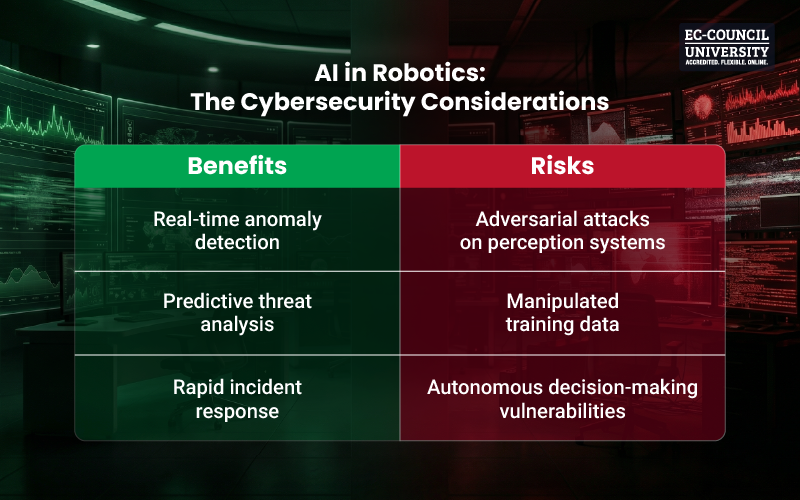
While AI is accelerating advancements in robotics, it’s also introducing new cyberattack surfaces.
On one hand, AI enables:
- Real-time anomaly detection
- Predictive threat analysis
- Rapid incident response
On the other hand, it introduces risks such as:
- Adversarial attacks on perception systems
- Manipulated training data
- Autonomous decision-making vulnerabilities
This is a turning point. AI is now both a defender and an attacker in robotics security.
Best Cybersecurity Practices for Securing Robotic Systems
Securing robotics requires a security-by-design mindset. These are the best cybersecurity practices to follow:
- Secure Development Lifecycle: Integrate security into every stage, from design to deployment.
- Strong Identity and Access Controls: Eliminate default credentials and enforce multi-factor authentication.
- Encryption Everywhere: Protect data in transit and at rest across all communication layers.
- Network Segmentation and Zero Trust: Treat every device and connection as untrusted.
- Continuous Monitoring: Use AI systems to detect anomalies in real time.
- Patch and Update Management: Ensure systems can be updated securely and regularly.
Compliance and Standards for Robotics
Frameworks that enforce a strong compliance model are:
- NIST Cybersecurity Framework
- IEC 62443 (industrial security)
- ISO standards for robotics
But compliance alone is not enough. Organizations must move beyond checkbox security and adopt risk-based, proactive strategies tailored to cyber-physical systems.
The Business Case for Cybersecurity in Robotics
Cybersecurity in robotics has become a business imperative because a single breach can result in:
- Operational downtime
- Financial losses
- Regulatory penalties
- Reputational damage
More importantly, organizations that prioritize cybersecurity gain a competitive edge by building trust, resilience, and reliability into their robotic systems and operations.
The Future of Robotics: Advanced Autonomy and New Risks
Looking ahead, robotics will become more autonomous, more mobile, and more interconnected. From smart factories to autonomous delivery systems and humanoid robots, the attack surface will continue to expand.
We are entering an era where:
- Robots move across networks and physical environments
- AI-driven robotic systems make independent decisions
- Cyber incidents can instantly translate into kinetic outcomes
This demands a new approach to cybersecurity, one that understands both computer science and consequences.
ECCU’s Master of Science in Computer Science: The Bridge Between Robotics and Cybersecurity
The Master of Science in Computer Science (MCS) program from EC-Council University (ECCU) offers a unique strategic pathway for professionals who aim to lead at the intersection of cybersecurity and emerging technologies, such as robotics. It’s designed with a clear recognition of where technology is headed. Rather than focusing narrowly on theoretical computer science, the program encompasses the real-world cybersecurity aspects of modern technology domains, including:
- Artificial Intelligence and Machine Learning (AI/ML)
- Robotics and autonomous systems
- Data science and analytics
- Secure software development
- Blockchain
This multidisciplinary approach is critical to ensuring that advancements in cybersecurity and robotics are made in tandem.

Key Benefits of ECCU’s Master of Science in Computer Science Program
- Embedded Cybersecurity Certifications for Real-World Validation: The program offers up to 3 industry-recognized cybersecurity certifications (CEH, CND, and CASE) integrated directly into the coursework. Along with a master’s degree, graduates also earn sought-after credentials that demonstrate their expertise.
- Hands-On Learning Through Virtual Labs: Cybersecurity, especially in robotics, cannot be mastered solely through theory. It requires hands-on experience in realistic environments. The MCS program addresses this through immersive virtual labs, where students can simulate cyberattacks and defense strategies, analyze vulnerabilities in complex systems, and practice securing interconnected technologies
- Flexible, Online Learning for Working Professionals: For many professionals, balancing education with career responsibilities is a major challenge. To solve this, ECCU offers a fully online, flexible learning model that allows you to study from anywhere, learn at your own pace, and apply concepts directly to your current role.
- Ideal for the Next Generation of Cybersecurity Leaders: What sets the MCS program apart is its alignment with the future of technology. As robotics, AI, and connected systems continue their symbiotic evolution, organizations will increasingly need professionals who can anticipate cyber-physical risks, secure autonomous systems, and function as both engineering and cybersecurity experts. This is exactly the kind of forward-thinking, technically skilled, and strategically aware talent the program nurtures.
Interested in knowing more about the MCS program?
Frequently Asked Questions About Cybersecurity in Robotics
Cybersecurity in robotics refers to protecting robotic systems (hardware, software, and communication networks) from cyber threats. It ensures that robots operate safely, securely, and without unauthorized interference, especially in connected environments like industrial automation and healthcare.
Cybersecurity is critical in robotics because robots are cyber-physical systems. Apart from data breaches, a successful cyberattack can also cause physical damage, operational disruption, and safety risks to humans. As robots become more connected, the potential consequences of attacks increase significantly.
Common threats include remote hijacking, malware and ransomware, denial-of-service (DoS) attacks, data interception, software vulnerabilities, supply chain attacks, and AI-based manipulation. These threats can compromise both digital systems and real-world operations.
Robots can be hacked through weak authentication, unpatched software, unsecured communication protocols, exposed APIs, or compromised third-party components. Network-based attacks such as man-in-the-middle (MITM) attacks are also commonly used to intercept or alter data.
Industries heavily reliant on robotics are most at risk, such as manufacturing, healthcare, logistics, defense, and autonomous transportation. These sectors depend on real-time operations, making them especially vulnerable to disruption and safety incidents.
Organizations can improve security by adopting a secure-by-design approach, implementing strong authentication, encrypting communications, applying regular software patches, using network segmentation, and continuously monitoring systems for anomalies.
Professionals need a combination of skills in cybersecurity, robotics, network connectivity, AI/ML, and software development. Understanding both digital architecture and physical processes is essential to securing modern robotic systems.