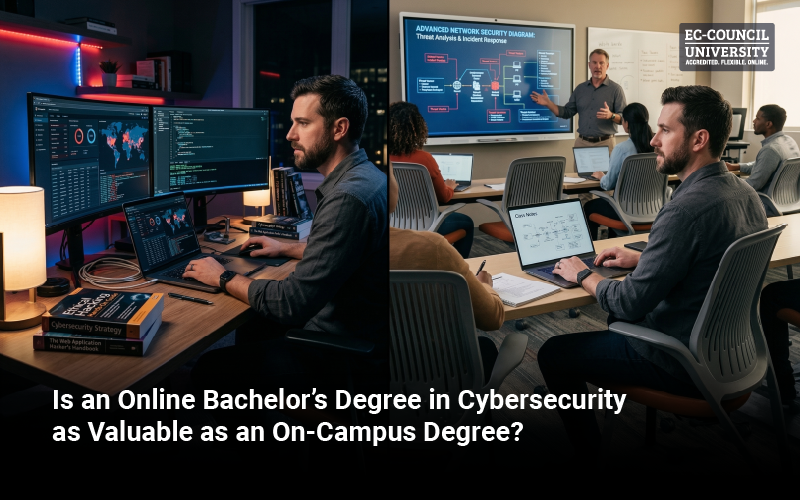
Why Cybersecurity Education Has Evolved Beyond Traditional Classroom Learning
Cybersecurity has become one of the fastest-growing fields worldwide. Organizations across industries are racing to hire qualified cybersecurity professionals. Yet the talent pipeline still struggles to keep up with demand. According to a recent cybersecurity workforce study, the global cybersecurity workforce gap exceeds 4 million professionals, underscoring a massive need for skilled talent worldwide. To meet this demand, universities have increasingly expanded online cybersecurity degree programs. What was once considered an alternative or secondary format is now a mainstream pathway into the cybersecurity profession.
However, skepticism still exists. Many prospective students wonder:
- Is an online bachelor’s in cybersecurity degree respected by employers?
- Does it provide the same practical skills as an on-campus program?
- Will graduates have similar career opportunities?
The reality is that the effectiveness of cybersecurity education depends far more on program design than on delivery format. A well-structured online program can often outperform traditional models when it emphasizes practical labs, certifications, and alignment with industry standards. A strong example of this modern approach is the fully online Bachelor of Science in Cyber Security (BSCS) from EC-Council University (ECCU), which integrates world-renowned cybersecurity certifications, an industry-aligned curriculum taught by experts, hands-on practice in virtual labs, and a globally connected classroom.
To understand why online cybersecurity degrees have gained strong credibility, it helps to define what “effective” cybersecurity education means.
What Does “Effective” Really Mean in Cybersecurity Education?
Unlike many academic disciplines, cybersecurity is a rapidly evolving technical field. New threats, tools, and attack techniques appear every year. Effective cybersecurity education, therefore, must prioritize three key outcomes:
- Practical Skills: Students must develop hands-on experience with the latest cybersecurity tools, penetration testing techniques, incident response workflows, threat intelligence platforms, and more.
- Industry Relevance: Programs should reflect real-world frameworks such as ethical hacking, network security, digital forensics, security operations, and threat intelligence.
- Employer-Recognized Credentials: Cybersecurity is one of the few professions where certifications carry significant weight alongside degrees.
In fact, the same cybersecurity workforce study cited above also shows that skill shortages, not just staff shortages, are one of the biggest challenges facing security teams today.
In other words, employers are not simply looking for graduates with theoretical knowledge. They need professionals who can secure networks, detect attacks, and respond to incidents from day one.
The Traditional On-Campus Model: Strengths and Limitations
Traditional campus-based education has long been the standard for university degrees. For many students, this type of learning format offers benefits such as:
- Structured schedules and academic oversight
- Face-to-face collaboration with professors
- Campus facilities and student communities
However, cybersecurity education faces a unique challenge: technology evolves faster than traditional academic cycles. University curriculum approvals often take years. By the time a course is fully approved, the technologies it covers may already be outdated. Cybersecurity threats evolve constantly, attackers adapt quickly, and security professionals must do the same.
This creates a gap between academic theory and real-world practice, a gap that modern online programs are designed to close.
The Modern Online Cybersecurity Education Model at ECCU
Online education has matured significantly in the past decade. Today’s best programs use advanced digital learning platforms, immersive labs, and interactive simulations to replicate, and often exceed, the hands-on experiences of physical classrooms. At EC-Council University (ECCU), students discover that rather than relying primarily on lectures, their cybersecurity education will emphasize:
- Hands-on practice with cutting-edge cybersecurity tools
- Virtual environments that mirror real-world security scenarios
- Unlimited practice sessions for sharpening cybersecurity techniques
Here’s a quick tour of ECCU’s virtual labs:
Embedded Certifications: A Major Differentiator
One of the biggest advantages of EC-Council University’s BSCS program is the integration of globally recognized cybersecurity certifications directly into the curriculum. Students have the opportunity to earn up to 5 respected industry credentials, such as:
- Certified Ethical Hacker (CEH)
- Certified Network Defender (CND)
- Computer Hacking Forensic Investigator (CHFI)
- Certified SOC Analyst (CSA)
- Certified Threat Intelligence Analyst (CTIA)
This embedded certification model offers two key advantages:
- Immediate Industry Credibility: While degrees demonstrate academic achievement, certifications signal specific technical capabilities. Employers frequently list cybersecurity certifications in job descriptions because they represent validated skills in areas like ethical hacking, penetration testing, network defense, digital forensics, incident response, and more
- Career Acceleration: Graduates who hold both a degree and professional certifications often stand out in the hiring process. Instead of entering the workforce with only theoretical knowledge, they demonstrate validated technical expertise recognized across the cybersecurity industry.
Most traditional campus programs do not integrate certifications into the curriculum, leaving students to pursue them independently after graduation.
Global Online Classroom vs Local Campus Classroom
Another major advantage of online cybersecurity programs is the ability to collaborate globally. Traditional on-campus programs typically consist of students from the same geographic region. In contrast, online programs often attract professionals from around the world and from different industries, countries, and job roles. This creates exposure to diverse security challenges and perspectives.
In cybersecurity, where threats operate globally, exposure to international perspectives can significantly enhance learning.
Online Cybersecurity Degrees Offer Unmatched Flexibility
Online education provides flexibility that traditional campus models cannot match. Key advantages include:
- Study Without Leaving Your Job: Working professionals can pursue a degree while continuing to build industry experience.
- Credit Transfer Opportunities: Students who already hold certifications or prior college credits may be able to transfer them into the program.
- Immediate Workplace Application: Many students apply newly learned skills directly in their current roles, reinforcing learning through real-world experience.
Career Outcomes: Do Online Graduates Get the Same Opportunities?
One of the most common questions prospective students ask is whether online graduates receive the same career opportunities as on-campus graduates.
The answer is YES, provided the program is reputable and aligned with current industry requirements. Employers care primarily about:
- Practical skills
- Relevant certifications
- Hands-on experience
- Problem-solving ability
The cybersecurity industry is particularly skills-driven. If graduates can demonstrate real-world competency, most employers place far less emphasis on whether their degree was completed online or on campus.
When an On-Campus Degree Might Be Better
While online cybersecurity degrees offer many advantages, they are not ideal for every learner. On-campus programs may be better suited for:
- Students Who Need High Structure: Some learners benefit from rigid schedules, in-person oversight, and traditional classroom environments.
- Recent High School Graduates Seeking Campus Life: For younger students, the social and developmental aspects of campus life may be an important part of the college experience.
- Students Who Prefer Face-to-Face Academic Support: Certain learners find it easier to ask questions and collaborate in person.
However, for working professionals, international learners, and career changers, online education is by far the more practical option.
Measuring ROI: Cost, Time, and Opportunity
Education is ultimately an investment, and students should evaluate degrees based on return on investment (ROI). Online cybersecurity programs often provide advantages in three areas:
- Lower Total Costs: Students can avoid expenses on relocation, campus housing, and commuting
- Time Efficiency: Flexible scheduling enables students to progress through coursework at their own pace and convenience.
- Career Continuity: Rather than pausing their careers, students can continue building professional experience while earning a degree.
For many learners, this combination presents a greater and more appealing ROI.
The Future of Cybersecurity Education Is Digital
Cybersecurity is a digital profession that protects digital infrastructure. It is therefore fitting that cybersecurity education itself is becoming increasingly digital. The most effective programs include:
- Hands-on technical skills
- Industry-recognized certifications
- Practice in virtual labs
- Global collaboration
The Bachelor of Science in Cyber Security (BSCS) program from ECCU reflects this modern philosophy. By combining flexible online learning with industry certifications and immersive cyber labs, the program prepares students for a global, virtual, and constantly evolving cybersecurity landscape. For more information about the program:
Frequently Asked Questions (FAQs)
Yes. Employers primarily evaluate cybersecurity candidates based on skills, certifications, and hands-on experience. Graduates from reputable programs with industry certifications are widely recognized in the job market.
Online programs can be equally rigorous. In many cases, they require strong self-discipline and independent learning while maintaining hands-on technical labs.
Many employers prefer candidates with both a degree and certifications. Credentials such as CEH, CND, or CHFI validate practical skills in ethical hacking, network defense, and digital forensics.
Yes. Online programs are designed to accommodate working professionals through flexible schedules, asynchronous learning, and remote labs.