Cybersecurity Jobs are More Important Than Ever
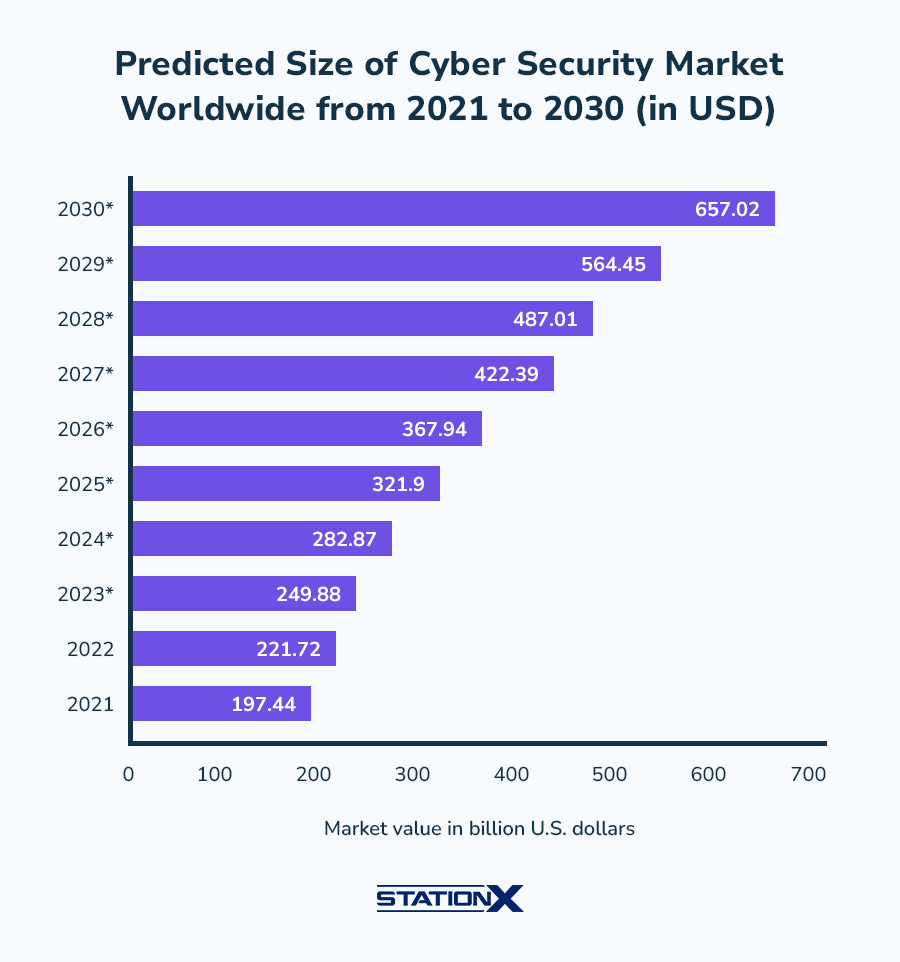
The cybersecurity industry is experiencing unprecedented growth — and for good reason. Organizations worldwide constantly face complex digital threats, resulting in a significant demand for skilled cybersecurity professionals. Here’s what the latest data tells us about the 2026 cybersecurity job market landscape:
- The global cybersecurity workforce gap is vast, with an estimated 3.1–3.5 million unfilled positions.
- Cybersecurity job postings are projected to grow 18–22% year-over-year, far outpacing many traditional IT roles.
- Average annual salaries range from $92,000 to $138,000, depending on experience, role, and region. Senior leadership roles (like CISO) can exceed $300,000.
The takeaway? The demand for cyber talent is expected to continue outpacing supply in 2026. If you build the right mix of skills and qualifications, you’ll be in a strong position to advance your career. An online cybersecurity master’s degree is a great way to accomplish this, and programs that embed globally recognized cybersecurity certifications directly into the curriculum provide major professional advantages over traditional programs that do not include certifications along with a degree.
What’s Influencing Current Cybersecurity Hiring Trends?
- Cloud security architecture
- Threat hunting and incident response
- Application security and DevSecOps
- Zero Trust and IAM implementation
- AI/ML security analytics
- Penetration testing and ethical hacking
- CEH (Certified Ethical Hacker) – for entry to mid-level penetration testing roles
- CPENT (Certified Penetration Testing Professional) – for advanced/senior-level penetration testing roles
- CHFI (Computer Hacking Forensic Investigator) – for digital forensics and cybercrime investigation roles
- CND (Certified Network Defender) – for defensive security operations
- CCISO (Certified Chief Information Security Officer) – for leadership/executive-level positions
- CCSE (Certified Cloud Security Engineer) – for specialized cloud computing cybersecurity roles
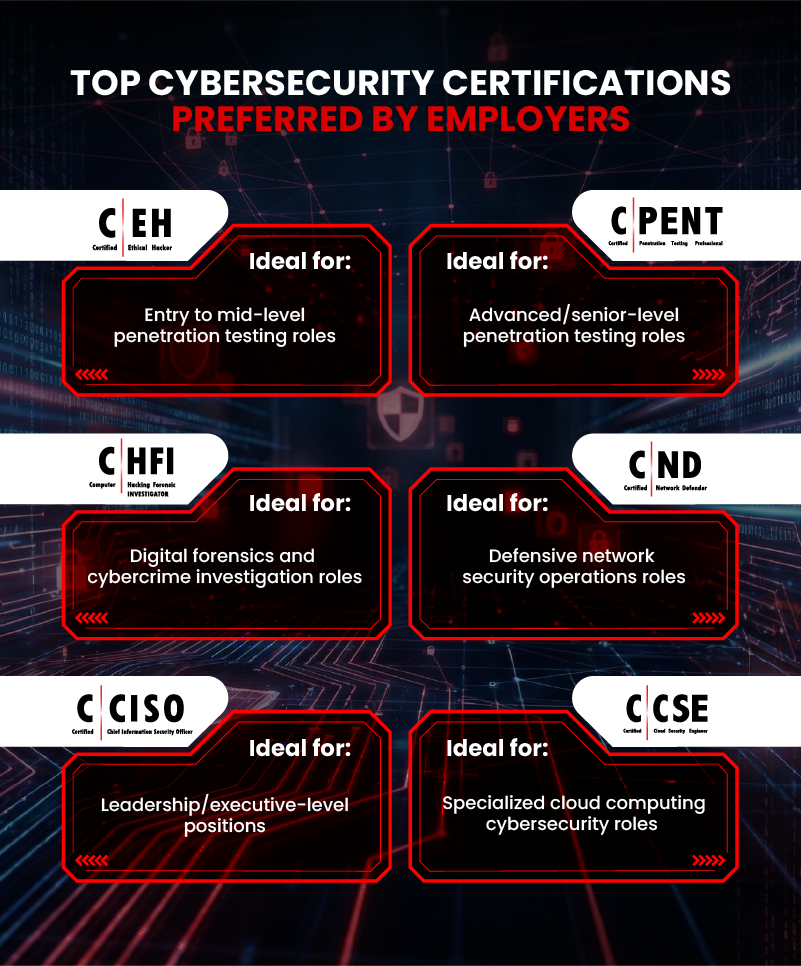
These skills and credentials align directly with what job postings and hiring managers are highlighting worldwide in 2026.
Why Degrees with Embedded Certifications Are Game-Changers
Traditional cybersecurity master’s degrees focus on theory, which is important, but employers today want talent who can hit the ground running. Programs with embedded certifications offer the best of both worlds by combining advanced academic knowledge with hands-on, industry-validated competencies.
The numbers speak for themselves:
- Graduates with embedded certifications see 25-40% higher starting salaries
- 78% of employers prefer candidates with both degrees and industry certifications
- Certification holders advance to senior roles 2x faster than those with degrees alone
When you pursue a master’s degree in cybersecurity with built-in certifications, you’re earning multiple credentials simultaneously, saving both time and money while maximizing your career potential.
What to Look for in an Online Cybersecurity Master’s Degree
Not all online cybersecurity degrees offer the same value proposition. When evaluating your options, prioritize these critical factors:
1. Embedded Industry Certifications
Look for programs that integrate certifications directly into coursework rather than offering them as an optional add-on. This approach ensures that you learn both the theoretical foundations and practical applications simultaneously.
2. Hands-On Virtual Labs
Cybersecurity is inherently practical. Your program should provide 24/7 access to virtual lab environments where you can practice real-world scenarios, from penetration testing to malware analysis.
3. Flexible Scheduling Options
The best programs cater to working professionals with asynchronous learning options, enabling you to balance work, studies, and personal life while advancing your education.
4. Credit Transfer Policies
Look for programs that extend generous credit transfer options. This can significantly reduce both the time to graduation and tuition costs.
5. Industry-Connected Faculty
Ensure your instructors bring current industry experience, not just academic credentials. The cybersecurity field evolves rapidly, and you need instructors who understand today’s threat landscape.
The ECCU Advantage: A Different Approach to Cybersecurity Education
For over 20 years, EC-Council University (ECCU) has been transforming the cybersecurity education landscape. A key aspect of this transformation is the Master of Science in Cyber Security degree, the first program to seamlessly embed multiple industry certifications into a comprehensive master’s degree curriculum. Here’s what sets it apart:
- 5 Specialization Options, Each with Multiple Certifications: Unlike traditional programs where certifications are separate pursuits, EC-Council University integrates valuable certifications like CEH, CPENT, CHFI, CND, CCISO, CCSE, and more directly into coursework. Graduates emerge with the immense career advantage of having both a master’s degree and industry-recognized credentials.
- Advanced Virtual Lab Infrastructure: The program provides 24/7 access to cutting-edge virtual labs that simulate real-world cybersecurity environments. Students practice a range of techniques, from ethical hacking to incident response procedures, using the same tools employed by professional cybersecurity teams.
- Accelerated Timeline Without Compromising Quality: Thanks to credit transfers, students can complete their degree in as little as 12 to 18 months while earning multiple certifications simultaneously. This dramatically enhances the return on investment compared to traditional programs.
- Real-World Application Focus: Every course emphasizes practical application over theoretical memorization. Students work on actual cybersecurity challenges that employers currently face, conduct penetration tests on realistic networks, and develop comprehensive security policies for various organizational contexts.
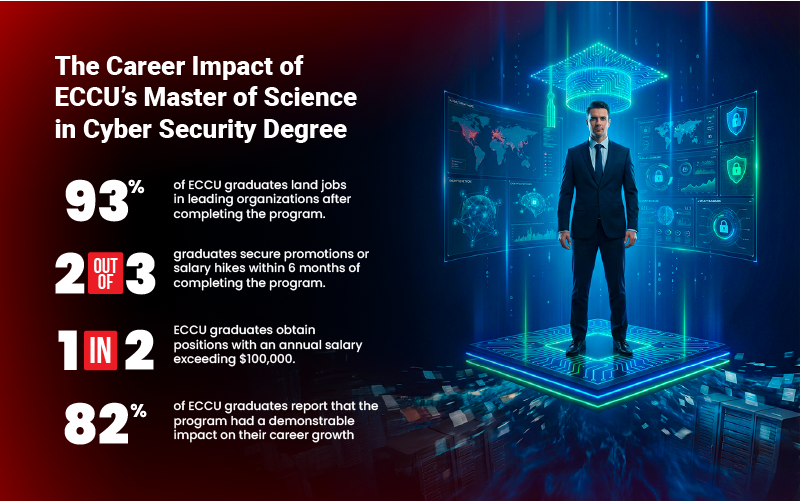
Degree + Certifications: An Excellent Return on Investment
The combination of a cybersecurity degree and multiple certifications doesn’t just look good on paper. It pays off:
- Greater opportunities to get lucrative jobs in competitive markets
- Higher starting salaries compared to non-certified candidates
- Accelerated career progress into leadership and specialized roles
In a job market where talent shortage is a primary concern, employers are willing to pay a premium for candidates with both deep theoretical knowledge and practical, validated skills.
How to Choose the Right Program for Your Career Goals
Selecting the ideal online cybersecurity master’s program requires careful consideration of your career objectives and current situation.
For Career Changers
If you’re transitioning from another field, prioritize programs with comprehensive foundational courses and strong career services support. Look for institutions that offer generous credit transfer policies, recognizing your existing education and experience.
For Current IT Professionals
Focus on programs that build upon your existing technical knowledge while adding specialized cybersecurity skills. Programs with embedded certifications are particularly valuable for demonstrating expertise to present and future employers.
For Busy Professionals
Prioritize programs with maximum flexibility – asynchronous coursework, 24/7 lab access, and accommodating faculty. The ability to progress at your own pace while maintaining work-life balance is crucial for long-term success.
Making Your Decision: Questions to Ask Program Advisors
Before enrolling in a master’s in cybersecurity program, ensure you have clear answers to these critical questions:
- Which specific certifications are embedded, and are exam vouchers included?
- What is the total time commitment for both degree and certification requirements?
- How current is the curriculum? When was it last updated to reflect modern-day threats?
- What career services support is available during and after the program?
- Can you speak with recent graduates about their career outcomes?
Your Cybersecurity Career Success Starts Here
The cybersecurity field offers tremendous opportunities for those with the right combination of education and credentials. By choosing a master’s in cybersecurity program with embedded certifications, you’re positioning yourself not just for immediate career success, but for long-term leadership in one of the world’s most critical and rewarding fields. Your cybersecurity career transformation starts with making an informed educational choice. A program that combines advanced academic rigor with hands-on, industry-validated skills is producing tomorrow’s cybersecurity leaders – and that could include you.
Ready to explore how embedded certifications can accelerate your cybersecurity career? Learn more about ECCU’s innovative approach to cybersecurity education and discover why industry leaders value our Master of Science in Cyber Security program.
Frequently Asked Questions (FAQs)
An online cybersecurity master’s degree with embedded certifications is a graduate-level program that integrates industry-recognized cybersecurity certifications directly into the curriculum. Instead of studying for certifications separately, students earn them concurrently with their academic coursework, gaining both theoretical knowledge and practical, job-ready skills simultaneously.
While a master’s degree in cybersecurity demonstrates advanced academic understanding, certifications validate hands-on, real-world expertise. Employers in 2026 prefer candidates who possess both. Certifications show that you can apply security concepts using current tools, frameworks, and methodologies, something a degree alone doesn’t always prove.
An online master’s degree in cybersecurity is ideal for:
- Prospective students seeking strong career outcomes
- Career changers transitioning into cybersecurity
- IT professionals looking to specialize or move into senior roles
- Working professionals who need flexible, online learning options
If you want a future-proof career in a high-demand field, an online cybersecurity master’s degree is a strong option.
ECCU’s Master of Science in Cyber Security program takes up to 24 months to complete. However, we offer transfer credits or accelerated pathways that enable motivated students to complete their degree in 12 to 18 months, depending on their prior education and experience.
Students who graduate with an online cybersecurity master’s degree with embedded certifications are prepared for roles such as:
- Senior Cybersecurity Analyst
- Penetration Tester / Ethical Hacker
- Incident Response Specialist
- Digital Forensics Analyst
- Cloud Security Engineer
- Security Architect or SOC Lead
- IT Security Manager
- Chief Information Security Officer (CISO)
- Director of Cybersecurity
- And many more