You’ve spent years earning certifications and have racked up credentials from EC-Council and other reputable cybersecurity institutions and universities. But what most people don’t realize is that those certifications aren’t just your resume boosters.
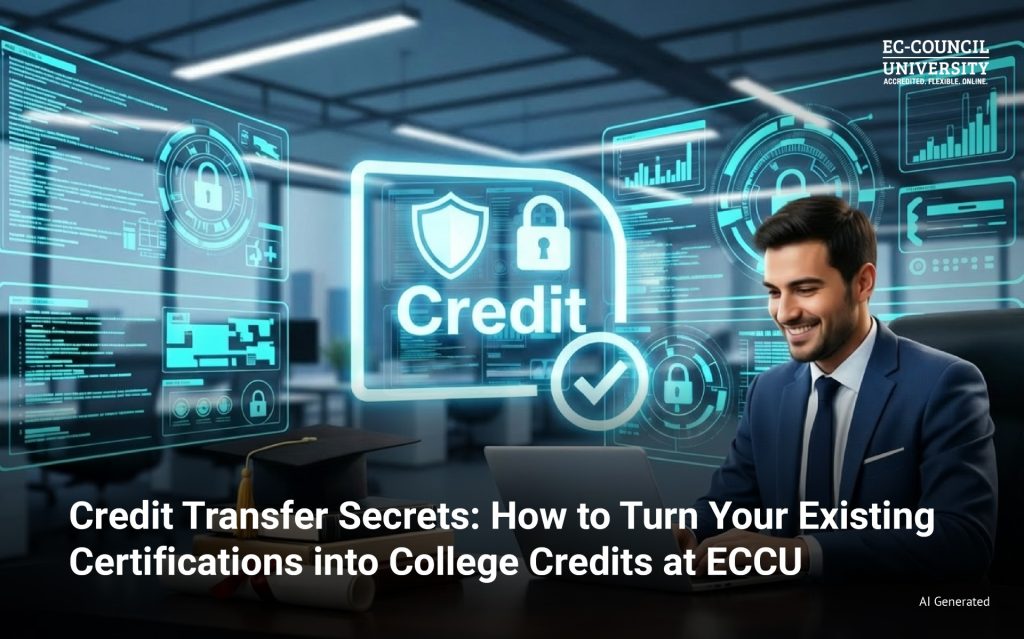
The certifications you earned can be used as college credits toward earning your cybersecurity degree. So, this means you can now graduate faster with lower tuition costs and enhance your credibility for the expertise you’ve already built.
EC-Council University (ECCU) offers a credit transfer opportunity in which your previously earned professional certifications from a reputable institute can directly translate into academic credits towards an ECCU degree.
Let’s break down exactly how this works.
The Hidden Value of Your Certifications

Most working professionals treat certifications and degrees as separate tracks. You earn certificates for immediate job relevance. You pursue degrees for long-term career growth. But what if you could merge these credentials to your benefit?
ECCU’s credit transfer system precisely does that. Through a prior learning portfolio assessment, the university evaluates your existing certifications and awards corresponding academic credits. Your certificates, like CEH or CND, aren’t just certifications; they are progress toward your bachelor’s or master’s degree.
Why it matters: The average cybersecurity professional holds 3-5 industry certifications. That’s dozens of credits already earned, sitting unused on your resume.
Which Certifications Qualify for Credit Transfer?
ECCU accepts certifications from most of the industry’s respected institutes, universities, and organizations. For instance, certifications earned from EC-Council, such as CEH, CHFI, CND, CPENT, or any other certificates from other institutes or organizations, are also accepted toward earning academic credits.
Each certification is mapped to specific course requirements within ECCU’s programs. The EC-Council University’s administrative team evaluates your credentials and determines the exact number of credits you have earned.
Essential requirement
Your certifications must not be more than one year past their expiration date to qualify. Active certifications receive full credit consideration.
Understanding the Credit Limits
Let’s talk numbers. ECCU has established clear guidelines for certification-based credit transfers:
For the Bachelor of Science in Cyber Security:
- Maximum 30 semester credit hours from industry certifications
- Total transfer credit cap of up to 90 hours (combining university coursework and certifications)
For Master’s Programs (including the MS in Cyber Security):
- Maximum 18 semester credit hours from industry certifications
These limits are generous. For context, a typical bachelor’s degree requires around 120 credit hours. If you maximize the 90-credit transfer opportunity, you are looking at completing just 30 additional credits to earn your degree.
That’s a significant shortcut.
The Three-Step Credit Transfer Process
Converting your certifications into college credits at ECCU follows a straightforward process:
Step 1: Document Your Certifications
Gather proof of all your active certifications. The documents should include official certificates, verification letters, or access to digital badge platforms where your credentials are stored.
Step 2: Submit for Assessment
When you apply to ECCU, include your certification documentation. The administrative team reviews each credential against the university’s course catalog.
Step 3: Receive Your Credit Mapping
ECCU provides a detailed breakdown showing which courses your certifications satisfy. You will know exactly where you stand before your first day of class.
Note: It is important to note that only one certification can be applied for a program. So, if you are considering both undergraduate and graduate studies, you’ll need to choose where to use the credential.

Real Impact of Credit Transfer in Terms of Time and Money Saved
Let’s put this in practical terms.
1. Time savings
A working professional completing a bachelor’s degree typically needs 3-4 years of part-time study. With 90 transfer credits, you could finish in as little as one year. That’s years of your life reclaimed.
2. Financial savings
Fewer credits mean lower tuition. Every course you skip through credit transfer is money that stays in your pocket. For many professionals, this represents thousands of dollars in savings.
3. Career acceleration
Every semester you shave off your degree timeline is a semester sooner you can get your degree and get promotions, salary increases, or new opportunities in your career.
Why ECCU's Model Works for Working Professionals
Credit transfer is just one aspect of ECCU’s approach to serving working cybersecurity professionals. The entire program structure is built around your reality to suit your professionals and personal commitment:
1. Flexible Schedule
Programs are designed for approximately 18 hours of study per week. You don’t need to quit your job or sacrifice family time to earn your degree.
2. Online Format
ECCU programs are 100% online, allowing you to study from anywhere, anytime. Complete coursework, balancing your professional and personal commitments.
3. Industry-Aligned Curriculum
Your coursework connects directly to real-world cybersecurity challenges and scenarios. What you learn on Monday can improve your work on Tuesday.
4. Embedded Certifications
If you are still building your certification portfolio, ECCU’s programs include preparation for credentials like CEH, CHFI, CND, CPENT, and more. You can prepare for and earn your certifications alongside your degree.
EC-Council University’s MS in Cyber Security has earned recognition for these reasons. The program ranks among Fortune’s Top 10 for online master’s degrees in cybersecurity, a testament to the quality and career impact of ECCU’s cybersecurity education.
Who Benefits Most from Credit Transfer?
Pursuing an online cybersecurity degree using academic credits from credit transfer works well for many profiles:
- Mid-career professionals with 5-10+ years of experience and multiple certifications. You’ve proven your expertise in the job. Now you need the academic credentials to match.
- Career changers who earn technical certifications before deciding to pursue formal education. Your self-study counts.
- Military veterans transitioning to civilian cybersecurity roles. Many service members hold certifications earned during their service. Combined with potential GI Bill benefits, credit transfer maximizes your educational investment.
- IT professionals ready for leadership roles. You have the technical certifications. A degree, especially a master’s degree, positions you for management and executive tracks.

Taking the Next Step In Your Cybersecurity Career
Your certifications represent real knowledge, real skills, and real professional investment. They shouldn’t disappear into a drawer once you’ve passed the exam.
At ECCU, the credentials you earn become your building block towards your degree. Whether you’re pursuing a Bachelor of Science in Cyber Security or advancing to a master’s program, your existing certifications can accelerate your journey of growth.
Ready to see how many credits you've already earned?
Contact ECCU’s admissions team for a personalized credit evaluation.
Bring your certifications and other relevant documents to evaluate and map out exactly how your credentials translate into academic progress.
Your cybersecurity career doesn’t have to wait. The credits you need might already be in your pocket.
Frequently Asked Questions
Certifications must not be more than one year past their expiration date.
No. Transfer credits do not count toward your cumulative GPA. Your GPA is calculated only from courses completed at ECCU.
No. Only one certificate can be applied to one program at a time. If you plan to pursue both a bachelor’s and a master’s degree, you’ll need to decide which program receives credit for each credential.
ECCU’s administrative team provides a detailed credit mapping after reviewing your documentation. This shows exactly which course requirements each certification satisfies.
You can submit all your qualifying certifications. However, the maximum credit awards are capped at 30 hours for undergraduate programs and 18 hours for graduate programs.