
Productivity Isn’t About Being Busy
In the modern-day professional environment, being busy is not particularly difficult. However, being effective is rare. Across industries, from cybersecurity and healthcare to finance and tech, professionals face constant demands like overflowing inboxes, urgent escalations, overlapping deadlines, and rising performance expectations. In high-pressure job roles, poor time management can decrease productivity and affect compliance, business continuity, revenue, and organizational reputation. This is why time management has become a strategic leadership skill.
The professionals who advance into senior roles are not necessarily those who work the longest hours. They are the ones who:
- Allocate attention strategically
- Prioritize high-impact work
- Make faster, smarter decisions under pressure
“Until we can manage time, we can manage nothing else.”
- Peter Drucker
(World-Renowned Management Thought Leader and Author)
Why Time Management Is Critical for Career Advancement
Many professionals assume career advancement depends solely on technical expertise. While technical skills are essential, leadership roles demand strategic focus and discipline in prioritization. Senior leaders are evaluated on their ability to:
- Set clear priorities
- Make decisions under pressure
- Manage competing risks
- Deliver consistent execution
Consider a cybersecurity analyst monitoring dozens of daily security alerts. Some alerts represent harmless system activity, while others indicate genuine threats. The analyst who can quickly identify high-risk signals amid operational noise demonstrates leadership-level thinking. This ability is essentially time management applied to decision-making.
According to a McKinsey global report, professionals spend approximately 28% of the workweek handling email alone, often at the expense of strategic work. Those who can filter distractions and focus on high-value work gain a significant competitive advantage.
The Unseen Costs of Ineffective Time Management
A lack of effective time management rarely causes immediate failure. Instead, it creates gradual erosion. Over time, professionals may experience:
- Missed strategic opportunities
- Reactive communication patterns
- Increased stress and burnout
- Reduced credibility with leadership
In cybersecurity environments, poor time management can have even greater consequences, including:
- Delayed incident response
- Incomplete vulnerability remediation
- Missed compliance reporting deadlines
- Weak risk communication to executives
While breaches often involve technical vulnerabilities, operational inefficiencies, such as delayed responses or overlooked alerts, can significantly amplify the damage.
The Best Time Management Techniques You Should Adopt
Efficiency is the name of the game for professionals in high-pressure job roles. The following time management tips help you maximize efficiency and the value of your work:
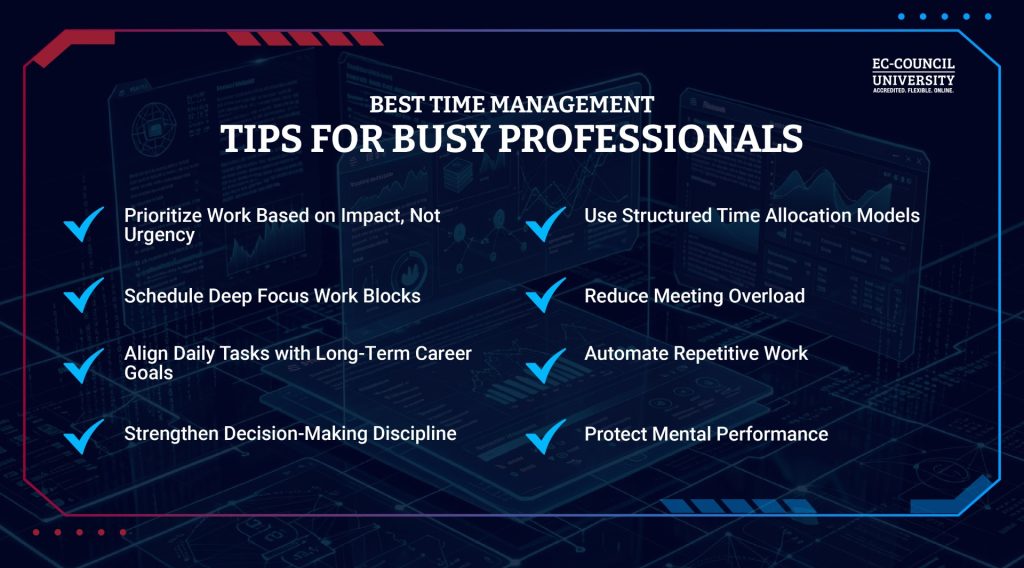
1. Prioritize Work Based on Impact, Not Urgency
Urgency often feels important. Impact determines importance.
High-performing professionals evaluate tasks using impact-based questions:
- What happens if this task is delayed?
- Does this affect revenue, compliance, or security posture?
- Who depends on the outcome?
- Does this align with strategic objectives?
In cybersecurity, for example, frequent low-severity alerts may appear urgent. However, a single misconfigured cloud permission that exposes sensitive data poses a much greater risk.
Professionals who prioritize impact over activity demonstrate strategic maturity. At EC-Council University (ECCU), graduate students develop this mindset through risk-based frameworks embedded in programs such as the Master of Science in Cyber Security. By learning to evaluate vulnerabilities in enterprise governance and risk contexts, professionals strengthen both their cybersecurity skills and their time management discipline.
2. Use Structured Time Allocation Models
Top-performing professionals rely on structured frameworks for time allocation. One effective approach is the Three-Level Work Model:
- Strategic Work: Long-term initiatives, planning, leadership activities, and innovation.
- Operational Work: Execution, project coordination, and technical responsibilities.
- Administrative Work: Email communication, documentation, and routine tasks.
Without structure, administrative tasks often expand and consume most of the workday. A Harvard Business Review study showed that executives spend about 23 hours a week in meetings, leaving little time for strategic work.
Dedicating bandwidth for strategic productivity is often the first visible indicator of leadership readiness.
3. Schedule Deep Focus Work Blocks
Constant interruptions significantly reduce cognitive performance. Research from the University of California, Irvine, shows that it requires an average of 23 minutes to refocus after an interruption.
For professionals in complex fields such as cybersecurity, deep concentration is essential for tasks like:
- Threat modeling
- Penetration testing
- Security architecture design
- Compliance analysis
- Incident investigation
Setting aside time for uninterrupted deep work sessions dramatically improves both speed and accuracy. Professionals pursuing executive-focused programs like the MBA in Cybersecurity at EC-Council University often develop structured thinking habits that depend on protected focus time, an essential skill for leadership roles.
4. Reduce Meeting Overload
Meetings can be necessary, but they frequently consume valuable time without clear outcomes. Before accepting a meeting invitation, consider the following:
- Is my presence required?
- What decision is expected?
- Can this be resolved asynchronously?
Business leaders are increasingly opting for ‘decision-first meetings’, where every meeting must produce a specific outcome. This approach can reclaim several hours per week for higher-value work.
5. Align Daily Tasks with Long-Term Career Goals
Effective time management isn’t just about productivity today. It’s about positioning yourself for the future. Professionals should regularly ask:
- Are my daily activities developing leadership capabilities?
- Am I improving communication and strategic thinking?
- Do my current responsibilities support my five-year career goals?
According to the World Economic Forum’s Future of Jobs Report 2025, analytical thinking and time management are among the top skills employers value.
Structured education can help professionals align skill development with career progression. Online programs and courses from EC-Council University are designed specifically for working professionals, allowing students to develop technical expertise, leadership capabilities, and time management discipline simultaneously while balancing demanding careers.
6. Automate Repetitive Work
Technology can eliminate many time-consuming tasks. In cybersecurity, automation tools assist with:
- Vulnerability scanning
- Threat detection
- Incident alerts
- Compliance reporting
In other industries, workflow platforms automate project tracking, approvals, and reporting. Automation allows professionals to shift focus from routine processing to strategic decision-making.
7. Strengthen Decision-Making Discipline
Indecision is a major time drain. High-performing professionals establish clear evaluation frameworks to accelerate decisions. In cybersecurity environments, prioritization decisions often rely on criteria such as:
- Risk severity
- Exploitability
- Regulatory impact
- Financial consequence
Structured learning environments reinforce these analytical frameworks. Programs at EC-Council University integrate real-world case studies and risk-analysis methodologies to help professionals make faster, more confident decisions under pressure.
8. Protect Mental Performance
Time management depends on mental clarity. Fatigue, stress, and burnout significantly reduce productivity and decision quality. According to the World Health Organization (WHO), burnout is now recognized as an occupational phenomenon linked to chronic workplace stress.
Professionals in demanding roles should treat recovery as performance maintenance, not a luxury. This includes:
- Adequate sleep
- Regular breaks
- Managing cognitive overload
High performers understand that sustainable productivity requires energy management as much as time management.
Common Time Management Mistakes to Avoid
Recognizing common time management mistakes can help shift from reactive work habits to more strategic productivity. Below are the time management pitfalls professionals should avoid:
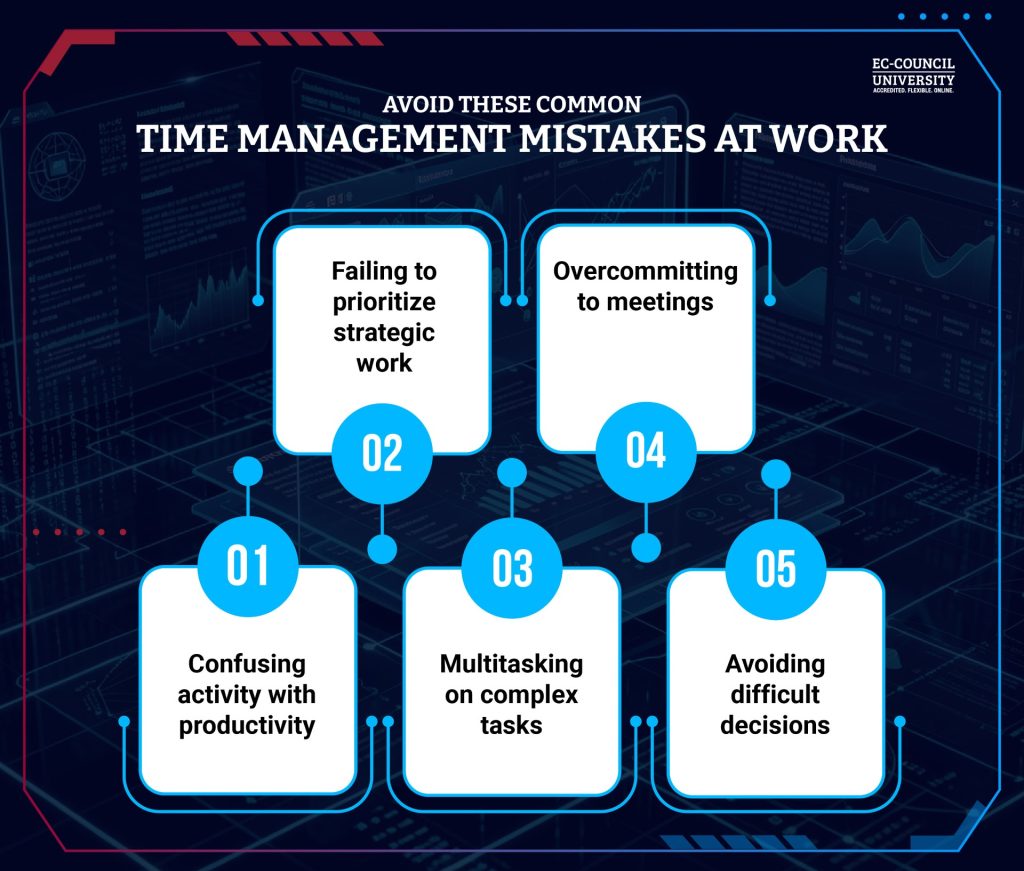
- Confusing activity with productivity: Being constantly busy doesn’t equal effectiveness. Focus on high-impact tasks that influence strategic outcomes rather than simply completing a large number of tasks.
- Failing to prioritize strategic work: Administrative and operational responsibilities often expand to fill the workday. Protect time for long-term initiatives, planning, and leadership-level contributions.
- Multitasking on complex tasks: Research from the American Psychological Association shows that multitasking can reduce productivity by up to 40% due to cognitive switching costs.
- Overcommitting to meetings: Many professionals attend meetings that add little value. Evaluate whether your participation is necessary and whether discussions can be handled asynchronously.
- Avoiding difficult decisions: Indecision wastes time and mental energy. Establish clear evaluation criteria to accelerate decision-making.
Career Advantages of Strong Time Management
Professionals who consistently manage time effectively often experience:
- Stronger performance evaluations
- Greater trust from leadership
- Increased visibility in strategic initiatives
- Faster career advancement
- Higher earning potential
In high-stakes industries like cybersecurity, the ability to prioritize effectively under pressure often distinguishes technical contributors from future executives.
Time management is not about doing more tasks. It is about consistently choosing the right tasks at the right time. And for professionals looking to strengthen both their technical expertise and leadership readiness, EC-Council University’s structured academic programs provide environments where time management, strategic thinking, and advanced technical skills develop together.
To know more about studying at ECCU:
Frequently Asked Questions
Start by prioritizing tasks based on impact rather than urgency. Use structured models to categorize work, protect deep focus time, and conduct weekly reviews to adjust priorities.
Leaders are evaluated on strategic focus and decision-making clarity. Effective time allocation demonstrates the ability to manage complexity and align work with organizational objectives.
Responding only to urgent requests, overcommitting to meetings, failing to align daily tasks with long-term goals, and neglecting structured prioritization frameworks are common mistakes.
In cybersecurity, prioritization affects incident response, compliance reporting, and executive communication. Strong time management strengthens credibility and positions cybersecurity professionals for leadership roles.