The Convergence of Cybersecurity and Remote Work
Remote work isn’t just a perk anymore. It’s a major driver of the tech sector’s employment strategy. Nowhere is this more apparent than in cybersecurity, a field at the intersection of digital risk management, data protection, and emerging technologies.
In the post-COVID era, cybersecurity professionals increasingly work from home or in hybrid environments, given the nature of their job. Analyzing systems, responding to threats, and designing defenses revolve around digital tools and cloud platforms. This flexibility makes cybersecurity one of the most attractive career options for anyone seeking impactful work, a favorable work-life balance, and the flexibility to work from anywhere.
Stats Highlighting the Boom in Remote Cybersecurity Jobs
Let’s ground this discussion with real numbers that illustrate the strength and demand of remote cybersecurity careers:
- Remote prevalence: More than 58% of cybersecurity roles in 2026 are offered as remote or hybrid work, reflecting industry adaptation to flexible schedules.
- Talent shortage: Global cybersecurity workforce shortage is projected to encompass 3.5 million unfilled roles, underscoring vast opportunities for trained remote professionals.
- Growth outlook: The U.S. Bureau of Labor Statistics forecasts nearly 30% job growth in information security roles through 2034, which is much higher than the average for all other occupations.
Together, these statistics underscore robust demand, widespread adoption of remote work, and the longevity of cybersecurity careers.
Top 10 Remote Cybersecurity Jobs in 2026
Below are the most in-demand remote cybersecurity jobs in 2026, along with job descriptions, responsibilities, and salary ranges*:
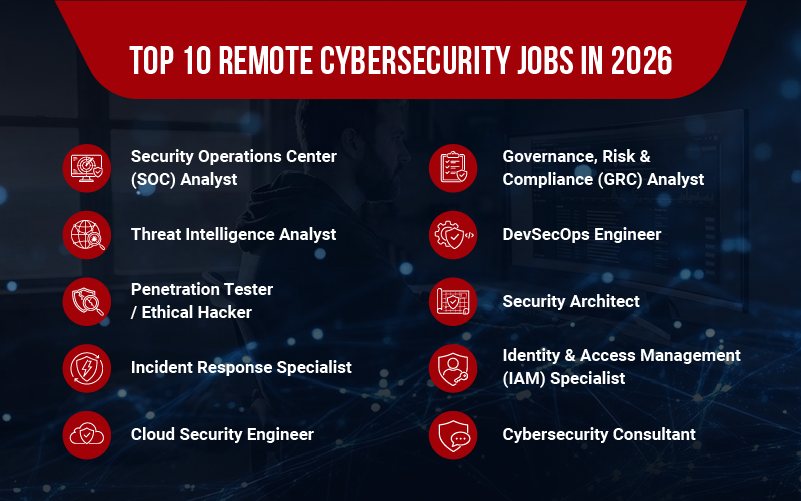
1. Security Operations Center (SOC) Analyst
- Description: Monitors security events, escalates alerts, and investigates incidents.
- Primary Responsibilities: Analyze logs, triage threats, report incidents, and maintain dashboards.
- Typical Salary Range: $90,000–$120,000
2. Threat Intelligence Analyst
- Description: Studies cyber threat actors to anticipate and mitigate attacks.
- Primary Responsibilities: Research threat vectors, prepare threat profiles, and collaborate with response teams.
- Typical Salary Range: $100,000–$130,000
3. Penetration Tester / Ethical Hacker
- Description: Simulates cyberattacks to find security weaknesses.
- Primary Responsibilities: Perform vulnerability tests, document exploits, and recommend fixes.
- Typical Salary Range: $110,000–$160,000
4. Incident Response Specialist
- Description: Manages and mitigates active security breaches.
- Primary Responsibilities: Evaluate breaches, coordinate recovery, and preserve evidence.
- Typical Salary Range: $110,000–$150,000
5. Cloud Security Engineer
- Description: Secures cloud infrastructures and services (AWS, Azure, GCP).
- Primary Responsibilities: Build secure cloud architectures, enforce policies, and conduct audits.
- Typical Salary Range: $130,000–$190,000
6. Governance, Risk & Compliance (GRC) Analyst
- Description: Ensures cybersecurity aligns with laws and internal policies.
- Primary Responsibilities: Risk assessments, control evaluations, and compliance reporting.
- Typical Salary Range: $100,000–$140,000
7. DevSecOps Engineer
- Description: Integrates security into software development cycles.
- Primary Responsibilities: Automate security checks, secure pipelines, and monitor vulnerabilities.
- Typical Salary Range: $120,000–$180,000
8. Security Architect
- Description: Designs robust security frameworks for enterprises.
- Primary Responsibilities: Develop high-level defense strategies and partner with software engineering teams.
- Typical Salary Range: $140,000–$200,000
9. Identity & Access Management (IAM) Specialist
- Description: Controls user and system access within IT environments.
- Primary Responsibilities: Configure IAM policies, manage privileges, and audit access logs.
- Typical Salary Range: $110,000–$150,000
10. Cybersecurity Consultant
- Description: Advises businesses on risk mitigation and security strategy.
- Primary Responsibilities: Conduct assessments, develop cybersecurity protocols, and present recommendations.
- Typical Salary Range: $120,000–$180,000
(*Salary figures reflect remote work premiums and market demand data where available)
Other Appealing Factors Beyond Remote Work
While the remote working aspect draws many professionals into cybersecurity, other career advantages make this field exceptional:
- Long-Term Job Security: Cyber threats evolve constantly, and organizations will continue investing in security, making cybersecurity roles future-proof.
- Career Growth and Advancement: Professionals can quickly move from entry-level roles to senior/executive-level positions with experience and certifications.
- Strong Salary Potential: Median salaries in cybersecurity regularly surpass many traditional IT roles (even at the beginner level) and increase significantly with experience.
- Continuous Learning Culture: Cybersecurity evolves with technology, offering constant opportunities to upskill and innovate.
- Meaningful Impact: Cybersecurity professionals protect critical systems, networks, and personal data, which benefits human societies at large.
Education and Qualifications Are Mandatory for Remote Cybersecurity Jobs
Remote work without foundational knowledge is a non-starter in cybersecurity, where decisions directly impact national, organizational, and individual safety.
- Technical Skills Are Non-Negotiable: Roles such as cloud security engineers, penetration testers, and DevSecOps specialists require deep technical expertise and hands-on skills that only cybersecurity education can provide.
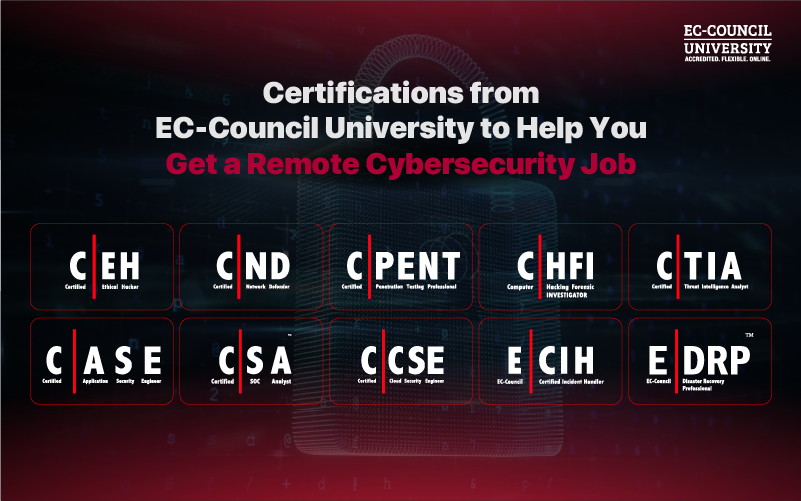
- Certifications Influence Salaries and Hiring: Professionals with credentials like CEH, CPENT, CTIA, CCSE, and CSA consistently command higher salaries and better remote opportunities.
- Hands-On Experience Is Expected: Employers prefer candidates with practical experience as well as theoretical knowledge. Structured academic programs provide both through hands-on labs, industry-aligned assignments, and capstone projects.
- Recruitment Standards Are Increasing: Despite the talent shortage and strong demand, employers are very selective when recruiting. Candidates often struggle to land desirable remote cybersecurity jobs without strong educational qualifications. Structured degrees and certifications address this gap.
ECCU: Your Gateway to Getting a Remote Cybersecurity Job
At EC-Council University (ECCU), our online cybersecurity degrees also include multiple globally recognized certifications. This combination gives you the perfect springboard to qualify for the remote cybersecurity job you desire.
Why EC-Council University?
- Hands-on virtual labs that simulate real-world cybersecurity scenarios.
- Valuable cybersecurity certifications integrated into degree pathways.
- Career support services geared toward remote and hybrid job markets.
- Faculty with deep cybersecurity experience and professional insights.
Whether you’re starting your career, switching fields, or aiming for leadership, ECCU prepares you to succeed in remote cybersecurity roles with the knowledge, confidence, and credentials employers demand.
Discover the ideal program for your career goals:
Frequently Asked Questions About Remote Cybersecurity Jobs in 2026
Yes. Remote and hybrid roles now account for a majority of cybersecurity positions, reflecting broader workplace flexibility trends.
Depending on a variety of factors, many remote positions offer comparable or even higher pay, though some companies adjust based on location or role.
Top certifications include CEH, CPENT, CCSE, CND, CTIA, CHFI, and ECIH, among others.
While some roles allow non-degree candidates with strong certifications, many competitive remote positions prefer or require a bachelor’s or master’s degree in cybersecurity.
Entry-level remote roles exist but may be competitive. Internships, certifications, and hands-on experience can significantly boost employability in this regard.
Technology, healthcare, finance, government, and consulting firms are major hiring sectors.
Remote cybersecurity jobs offer flexibility and location independence, but hybrid arrangements still dominate in some organizations, especially in sensitive or classified environments.
Competition is increasing, especially for fully remote positions. Building specialized skills and credentials gives applicants crucial competitive advantages.