
Have you been overwhelmed by the fast-paced cybersecurity industry?
Staying constantly updated can be challenging, especially when you need to balance your personal and professional commitments. While employers want real skills, professionals or learners like you want real results, and education that fits into real life.
That’s exactly where ECCU’s Non-Degree Status (NDS) Courses fit in.
Designed for aspiring and experienced professionals, the NDS Courses help you gain specialized cybersecurity knowledge, earn industry-recognized EC-Council certifications, and stay competitive, without having to commit to a long-term, traditional degree.
Sounds interesting?
Here’s more to it!
NDS Courses are low-cost investments but still offer high returns. And this is proven. Explore NDS Courses: Who are these Courses meant for? And most importantly, how can they impact your career?
What Is the NDS Course?
The Non-Degree Status (NDS) Course is a focused, career-driven learning pathway designed to quickly and effectively build job-ready cybersecurity skills.
Unlike traditional degrees, these Courses eliminate general education requirements and focus entirely on practical, hands-on cybersecurity Courses. Each Course is closely aligned with EC-Council certifications, making them highly relevant in today’s security job market.
In short, ECCU’s non-degree Courses are:
- Skill-focused and industry-aligned
- Designed for faster completion
- Built around real-world cybersecurity roles
- Ideal for professionals seeking immediate impact
Who Should Consider ECCU’s Non-Degree Courses?
ECCU’s cybersecurity Non-Degree Courses are designed for learners at various stages of their careers.

1. Working Professionals
Already in IT or cybersecurity? The NDS Courses help you build or improve your skills, specialize, and advance, without taking a career break.
2. Career Switchers
Looking to enter cybersecurity? NDS Courses offer a structured, hands-on pathway into the field.
3. Certification-Driven Learners
If your goal is to earn a cybersecurity certificate aligned with EC-Council, NDS Courses provide targeted preparation.
4. Busy Learners
With flexible online learning, you can study anytime, anywhere, making it easier to balance work, life, and education.
Popular Non-Degree Courses Offered by ECCU
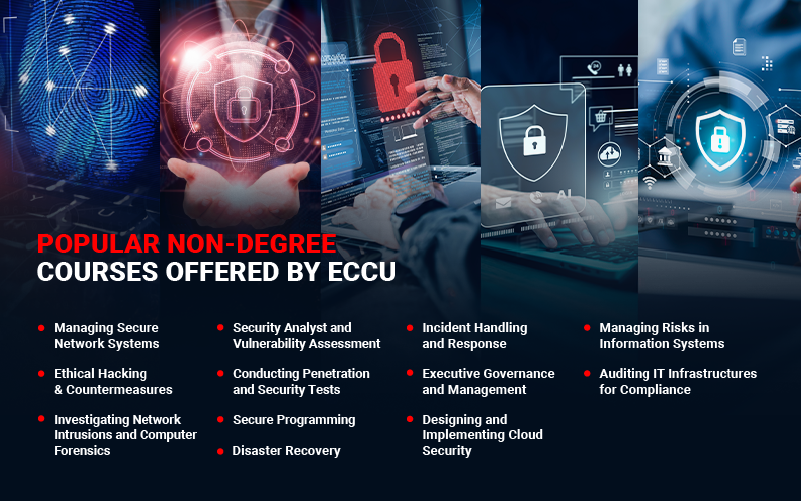
ECCU’s non-degree Courses cover some of the most in-demand cybersecurity domains, including:
1. Managing Secure Network Systems
Focus: Network defense strategies, secure architecture, monitoring, and hardening practices.
The non-degree Course focuses on network and IT security, covering how to identify vulnerabilities and defend systems against threats. It teaches the design and implementation of security policies, firewall strategies, and intrusion detection. Key topics include network protocols and attacks, system hardening, VPNs, email security, and fault tolerance.
Aligned with EC-Council Certification: Certified Network Defender (CND)
2. Ethical Hacking & Countermeasures
Focus: Ethical attack methodologies, vulnerability exploitation, and defensive countermeasures.
The Course explores the function of perimeter defense, how attackers gain and escalate privileges, and practical methods for securing IT systems. It also examines intrusion detection, security policy development, social engineering techniques, DoS attacks, buffer overflows, and the fundamentals of viruses.
Aligned EC-Council Certification: Certified Ethical Hacker (CEH)
Explore Ways of Upskilling with Ethical Hacking Certifications Through A Non-Degree Path here
3. Investigating Network Intrusions and Computer Forensics
Focus: Digital forensics, intrusion analysis, evidence handling, and investigative procedures.
The Course covers strategies for preventing, detecting, and responding to cyberattacks, with an emphasis on countering cybercrime, cyberterrorism, and online predators. It also introduces computer forensics, forensic analysis, network surveillance, intrusion detection, security policies, anonymity, and real-world case studies.
Aligned EC-Council Certifications: Computer Hacking Forensic Investigator (CHFI)
4. Security Analyst and Vulnerability Assessment
Focus: Vulnerability assessment, threat analysis, and security posture evaluation.
This Course teaches how to design, secure, and test networks to protect organizations from cyber-attacks. It focuses on identifying, preventing, and resolving security issues, with comprehensive coverage of network security testing and analysis.
5. Conducting Penetration and Security Tests
Focus: Advanced penetration testing, exploitation techniques, and professional reporting.
This Course focuses on conducting effective penetration testing in enterprise network environments. It covers penetration testing methodologies, scoping and engagement, OSINT, social engineering, and testing of external, internal, and perimeter networks.
Aligned EC-Council Certifications: Certified Penetration Testing Professional (CPENT)
6. Secure Programming
Focus: Secure software development, application vulnerabilities, and secure coding practices.
This Course builds fundamental secure programming skills by addressing common causes of vulnerabilities and buggy code. It highlights security weaknesses in programming languages and architectures and teaches secure coding practices to prevent exploits and eliminate bugs.
Aligned EC-Council Certifications: Certified Application Security Engineer (CASE)
7. Disaster Recovery
Focus: Business continuity planning, recovery strategies, and resilience management.
This Course focuses on cybersecurity disaster recovery, covering risk assessment, policy and procedure development, and organizational roles and responsibilities. It teaches how to create, test, implement, and execute disaster recovery plans, with an emphasis on identifying vulnerabilities and preventing information failure risks.
Aligned EC-Council Certifications: EC-Council Disaster Recovery Professional (EDRP)
8. Incident Handling and Response
Focus: Incident detection, containment, eradication, and post-incident analysis.
This Course covers key principles and techniques of threat detection and response while also focusing on computer forensics. It builds proficiency in handling network breaches, malware attacks, or any insider threat. The course also covers incident response and management, as well as recovery techniques.
Aligned EC-Council Certifications: EC-Council Certified Incident Handler (ECIH)
9. Executive Governance and Management
Focus: Security governance, leadership, policy development, and executive decision-making.
This Course prepares learners for C-level security leadership by integrating governance, risk management, controls, auditing, and security operations. It also covers core information security concepts, as well as strategies for strategic planning, finance, budgeting, and vendor management, which help lead a successful enterprise security program.
Aligned EC-Council Certifications: Certified Chief Information Security Officer (C|CISO)
10. Designing and Implementing Cloud Security
Focus: Cloud security architecture, access controls, data protection, and compliance.
The NDS Course provides comprehensive knowledge of cloud services, including their features, benefits, applications, and various cloud service models. The Course covers everything from planning, designing, and implementing cloud security controls to covering standards and best practices. The course also addresses business aspects such as uptime, availability, fault tolerance, failover policies, and how security supports cloud adoption.
Aligned EC-Council Certifications: Certified Cloud Security Engineer (CCSE)
11. Managing Risks in Information Systems
Focus: Risk management frameworks, compliance requirements, and organizational security strategy.
This Course covers the core components of threat intelligence, including countermeasures against cyber-attacks, identification of IT system vulnerabilities, and the development of effective cybersecurity strategies. It also trains you to design comprehensive threat intelligence Courses aligned with organizational risk management.
Aligned EC-Council Certifications: Certified Threat Intelligence Analyst (CTIA)
12. Auditing IT Infrastructures for Compliance
Focus: Assess IT infrastructures for policy and regulatory compliance, evaluate controls, identify gaps, and support audit reporting and remediation.
This Course equips you to lead a Security Operations Center (SOC) team, protecting your organization from cyber threats while ensuring compliance with various regulations. It provides advanced skills in SOC processes, including log management, SIEM deployment, incident detection, and response.
Aligned EC-Council Certifications: Certified SOC Analyst (CSA)
Key Benefits of ECCU’s NDS Course
1. Shorter Time Commitment
One of the most significant advantages of non-degree Courses is speed. Instead of spending years in school, learners can often complete a Course in a matter of weeks or months.
This makes it easier to:
- Gain new skills quickly
- Respond to job market changes
Avoid long academic timelines


2. Hands-On Learning with Real Tools
Another benefit is gaining hands-on experience. Learners work with state-of-the-art cybersecurity tools through immersive virtual labs.
3. Career-Focused Curriculum
The Courses focus on what matters most in the workplace, emphasizing practical knowledge, skill application, and industry-relevant concepts that help learners use what they learn immediately, whether on the job or in their job search.


4. Industry-Recognized Certifications
Each Course supports EC-Council certifications, giving learners credentials that employers trust.
5. Flexible Online Learning
Study online, from anywhere, ideal for working professionals who want to advance without disrupting their careers.


6. Affordable Education
Compared to traditional degrees, cybersecurity Courses are significantly less expensive.
7. High Earning Potential
Graduates of NDS Courses will have the opportunity to secure roles with salaries exceeding $100,000*, demonstrating strong ROI.

Why ECCU’s NDS Courses make financial sense:
The non-degree courses are affordable.
Instead of paying for years of coursework, learners invest only in relevant, career-focused training.
- Low-cost cybersecurity courses.
- Shorter duration and faster completion
- Pay only for skills that directly impact your career
For learners seeking a budget-friendly entry into cybersecurity, these courses offer an excellent return on investment.
How Does the NDS Course Impact Your Career & ROI
1. Skills Employers Actively Seek
NDS Courses help you build practical skills that employers value, including hands-on experience, certification-aligned knowledge, and real-world application.
2. Improved Employability
Graduates use these cybersecurity certificate Courses to:
- Strengthen resumes
- Transition into specialized roles
- Advance within their organizations
3. A Steppingstone to Further Education
Many learners begin with a non-degree certification and later choose to pursue a full degree, making NDS a low-risk starting point.
Enrollment Process for ECCU’s NDS Courses
Getting started with ECCU’s Non-Degree Status Courses is simple, transparent, and designed for busy professionals.
Admission Criteria
To enroll in ECCU’s Non-Degree Courses, you must:
- Be 18 years or older
- Hold a high school diploma (or equivalent), a college degree, or a relevant professional certification
How to Apply
Step 01: Fill out the NDS application form and submit it to an ECCU Enrollment Advisor.
Step 02: Email a scanned copy of:
- Official government-issued identification
- Documents showing proof of education
Step 03: Pay a one-time $100 application fee to complete your application.
Once submitted, the enrollment team will guide you through the next steps and help you choose the right cybersecurity Course based on your goals.
Is the NDS Course Right for You?
Choose Non-Degree Courses If You:
- Want fast, practical cybersecurity skills
- Prefer flexible online learning
- Need an affordable alternative to full degrees
- Want immediate career impact through certifications
Many professionals successfully combine both NDS and a Degree at different stages of their careers.
NDS Course Is Right For You
To know More, Read here
Is ECCU’s NDS Course Worth It?
ECCU’s Non-degree Status is absolutely worth considering.
They allow you to:
- Build in-demand cybersecurity skills
- Earn trusted industry certifications
- Advance your career faster
Ready to Take the Next Step?
Explore ECCU’s non-degree certification courses, connect with an enrollment advisor, and choose a cybersecurity path that fits your goals—because in cybersecurity, the right skills at the right time can open powerful new opportunities.
Frequently Asked Questions (FAQ)
Yes, the credits earned upon completing the embedded certification within the course can be transferred to the degree. However, we recommend checking with an ECCU Enrollment Advisor for appropriate guidance.
Many employers value practical skills and professional certifications, especially when they are aligned with job requirements.
Non-degree courses do not require prior experience. They are designed for beginners and working professionals.