Cyber Threats Don’t Recognize Borders
Cybercriminals do not respect sovereign or political boundaries, and their malicious actions can reverberate worldwide. A ransomware attack launched in Eastern Europe can cripple a hospital system in the United States within minutes. A phishing campaign originating in Southeast Asia can compromise financial institutions in Europe overnight. In today’s hyperconnected world, cyber threats move faster than ever, crossing borders and time zones with ease. Cybersecurity Ventures estimates that global cybercrime costs may have reached $10.5 trillion annually, making it one of the largest economic threats worldwide.
This deeply concerning situation has skyrocketed the demand for cybersecurity professionals who think beyond local systems and understand global threat dynamics. Cybersecurity education must evolve accordingly. If cyber threats are global, then cybersecurity learning must be global too.
Why a Global Perspective Matters in Cybersecurity
Different Regions, Different Threat Landscapes
Cyber threats are not uniform, and each region faces unique attack patterns shaped by economic conditions, political environments, and technological maturity.
- North America: Highly targeted ransomware and supply chain attacks
- Europe: Strong focus on privacy compliance and data protection
- Asia-Pacific: Rapid digitization leading to increased phishing and mobile-based attacks
- Middle East: Nation-state cyber warfare and critical infrastructure targeting
A cybersecurity professional trained in only one regional context risks missing the broader threat picture.
Understanding Global Regulations and Compliance
Cybersecurity is deeply intertwined with legal and regulatory frameworks. Professionals must navigate:
- GDPR in Europe
- HIPAA in the U.S.
- Data localization laws in countries like India and China
Without a global perspective, organizations may face compliance risks that bring hefty financial penalties and irreversible reputational damage.
Strengthening Incident Response and Decision-Making
A global mindset enables professionals to:
- Recognize emerging threats early based on patterns seen in other regions
- Coordinate cross-border incident response efforts
- Apply diverse strategies to complex cyber challenges
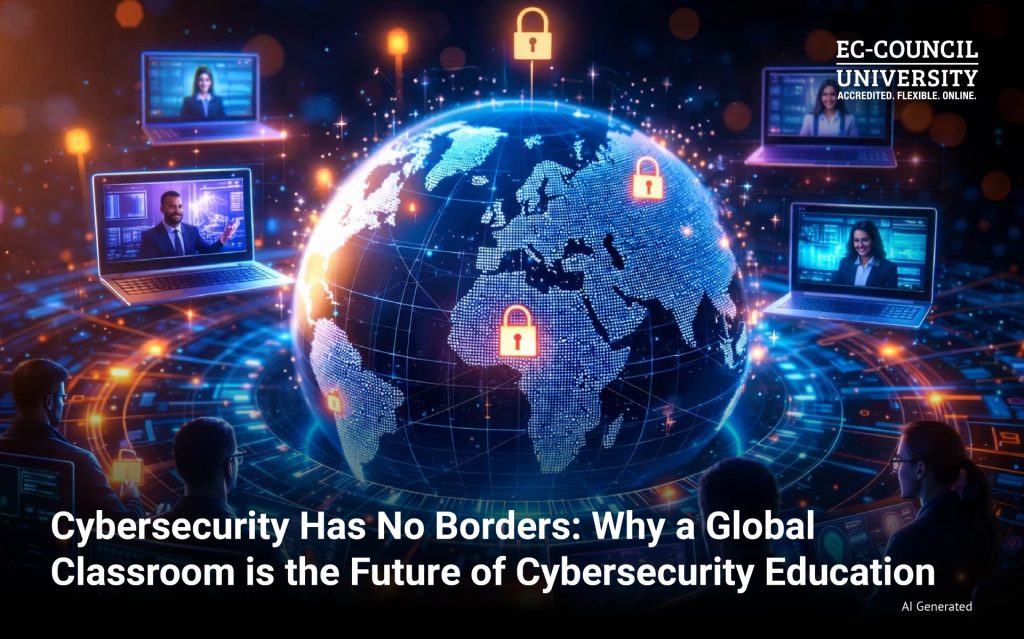
What is a Global Classroom?
A global classroom is more than just an online learning environment. It is an ecosystem where students from across continents collaborate, learn, and solve real-world cybersecurity challenges together. EC-Council University (ECCU) is a prime example where global classrooms bring together students from:
- North America
- Europe
- Asia
- Africa
- The Middle East
This diversity creates a dynamic learning culture in which multiple perspectives enhance every discussion.
Learning from Peers Across Borders
Peer-to-Peer Learning as a Core Model
One of the most powerful aspects of a global classroom is peer-to-peer learning, where students learn from each other and from instructors.
Imagine analyzing a ransomware case study with:
- A security analyst from Germany
- A network engineer from India
- A compliance officer from the UAE
Each brings unique insights shaped by their regional experiences.
Real-World Case Discussions
Cybersecurity is practical and evolving, which is why global classrooms emphasize:
- Case-based learning
- Real-world incident analysis
- Collaborative problem-solving
Students with firsthand experience of unique cyber incidents enrich these discussions.
Building Analytical and Leadership Skills
Global collaboration fosters:
- Critical thinking
- Cultural intelligence
- Leadership in diverse teams
These skills are essential for modern-day cybersecurity leaders.
Networking in a Borderless Cybersecurity Community
In cybersecurity, who you know can be just as important as what you know. ECCU’s global classrooms create opportunities to build a truly international network of:
- Cybersecurity professionals from various sectors
- Industry leaders and innovators
- Government and defense experts
This network becomes invaluable for:
- Exclusive career opportunities
- Knowledge and resource sharing
- Collaborative defense strategies
A student in one country today could become your incident response partner tomorrow.
Collaboration Through ECCU’s Online Learning Management Platform
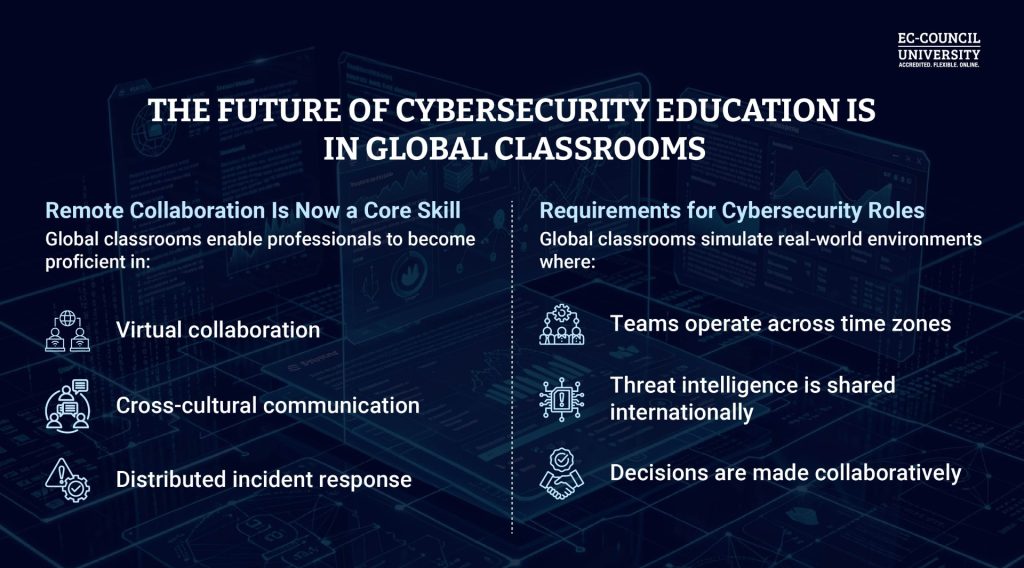
ECCU’s advanced online learning platform enables seamless global collaboration through:
- Discussion forums
- Group projects
- Virtual labs
- Interactive assignments
- 24×7 online library
Students work together in real time and asynchronously, simulating the distributed nature of modern cybersecurity teams. Organizations these days rely on distributed teams for cybersecurity operations, making remote collaboration a critical skill. ECCU ensures students graduate with job-ready experience in exactly this kind of environment.
Career Growth Advantages of a Global Classroom
A global education translates directly into career advantages.
Increased Employability
Employers are actively seeking professionals who:
- Understand international threat landscapes
- Can work across borders
- Are comfortable in remote, diverse teams
Leadership Opportunities
Global exposure prepares students for roles such as:
- Chief Information Security Officer (CISO)
- Global Security Operations Lead
- Director of Cybersecurity
Competitive Differentiation
In a crowded job market, a global perspective sets candidates apart. It signals:
- Adaptability
- Awareness
- Readiness for globally connected challenges
ECCU Programs That Deliver a Global Learning Experience
ECCU offers a range of programs designed to maximize the benefits of a global classroom, including:
- Bachelor of Science in Cyber Security (BSCS) degree
- Master of Science in Cyber Security (MSCS) degree
- Master of Science in Computer Science (MCS) degree
- Master of Business Administration (MBA) degree
- Graduate certificate programs in specialized cybersecurity domains
Each program integrates:
- Global case studies
- Collaborative projects
- Real-world applications
- Hands-on practice in virtual labs
- Multiple certifications
Learn Cybersecurity Without Borders at ECCU
Cybersecurity is no longer confined to a single organization, country, or region. It is a global discipline that demands global thinking. ECCU’s online programs facilitate global classrooms that empower students to:
- Gain diverse perspectives
- Collaborate across cultures
- Build international networks
This is more than education. It’s preparation for the realities of modern cybersecurity. If you want to lead in cybersecurity, you must think globally. Build global connections while mastering cybersecurity by joining our international learning community today. For more information:
Frequently Asked Questions
A global perspective helps professionals understand regional threat patterns, comply with international regulations, and respond effectively to cross-border cyber incidents.
A global classroom is an online learning environment where students from different countries collaborate, share insights, and learn from diverse real-world cybersecurity experiences.
ECCU offers 100% online, asynchronous programs with international student cohorts, collaborative projects, and real-world case studies that reflect global cyber threats.
Yes. ECCU’s online cybersecurity programs include virtual labs, case studies, and peer collaboration that simulate real-world cybersecurity environments and challenges.
Global networking provides access to international job opportunities, knowledge and resource sharing, and reputation-boosting collaborations with professionals across different regions and industries.