Keep Accreditation in Mind Before You Sign Up for an Online Cybersecurity Degree
When evaluating an online cybersecurity degree, most people instinctively focus on cost, flexibility, depth of curriculum, university reputation, and value. These factors undoubtedly matter, but they should not override the importance of accreditation. Accreditation must be the primary filter applied when assessing your options.
That’s because accreditation determines whether your degree will be recognized, respected, and useful after graduation. Without valid accreditation, even the most affordable or flexible program may fail to deliver real career value. It directly impacts credit transferability, eligibility for federal financial aid, and employer trust. In cybersecurity, a field where credibility and verification are everything, this carries even greater significance.
“Accreditation ensures that institutions of higher education meet acceptable levels of quality.”
– U.S. Department of Education
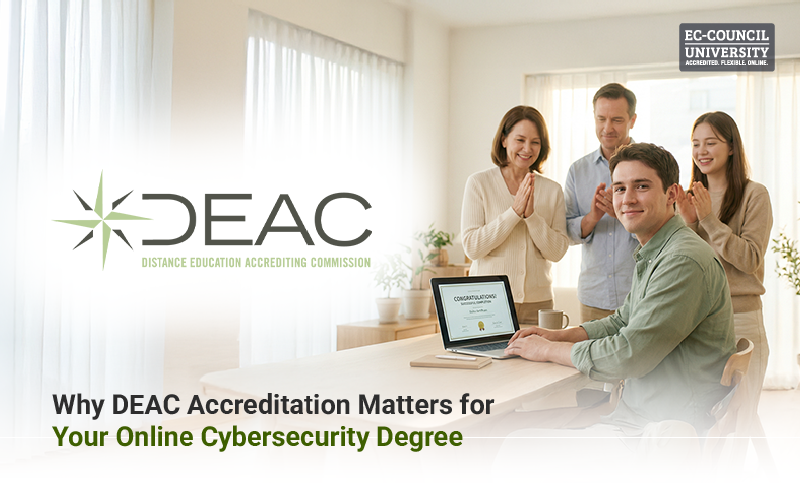
What Is DEAC Accreditation?
– Understanding DEAC
The Distance Education Accrediting Commission (DEAC) is a nationally recognized accrediting agency that specializes in distance and online education. It is recognized by both the U.S. Department of Education and the Council for Higher Education Accreditation (CHEA).
DEAC focuses specifically on institutions that deliver education remotely, making it uniquely relevant in today’s digital-first learning environment.
– What DEAC Evaluates
Beyond being a rubber stamp, DEAC accreditation mandates that institutions undergo rigorous evaluation across numerous criteria, including:
- Academic rigor and curriculum quality
- Faculty qualifications
- Student support services
- Ethical business practices
- Learning outcomes and assessment methods
Institutions must also demonstrate continuous improvement and accountability to maintain their accreditation status.
Why DEAC Accreditation Matters for Students
- Degree Credibility: A DEAC-accredited degree indicates that your education meets established quality standards. Employers increasingly verify academic credentials, especially in cybersecurity roles where trust is critical. A recognized accreditation assures them that your knowledge and training are legitimate.
- Eligibility for Financial Aid and Benefits: Accreditation directly impacts your access to financial resources. Students enrolled in accredited institutions may qualify for federal financial aid programs through the Federal Student Aid, as well as employer tuition reimbursement programs. Without accreditation, these opportunities are often unavailable.
- Quality Assurance: DEAC accreditation ensures that your education is effective and up-to-date. In a field evolving as rapidly as cybersecurity, outdated or poorly structured programs can leave graduates underprepared for current industry challenges. Accreditation helps safeguard against this risk by enforcing continuous curriculum review and enhancement.
DEAC vs. Traditional Accreditation: What’s the Difference?
People are often confused by the distinction between DEAC (national accreditation) and traditional regional accreditation. Here’s the practical difference:
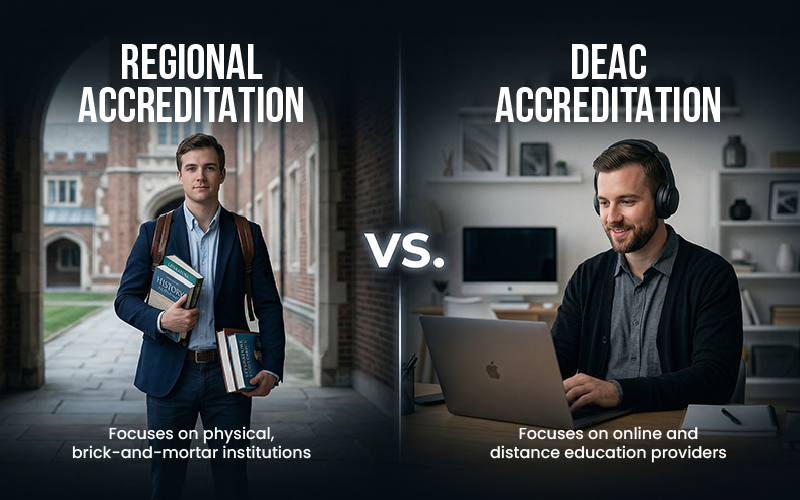
The U.S. Department of Education recognizes both. However, DEAC is uniquely designed for modern, flexible learning environments. For online learners, this specialization can be an advantage, ensuring that the institution is optimized for digital delivery rather than adapted to it.
Why DEAC Accreditation Is Especially Relevant for Online Cybersecurity Degrees
The ideal environment for learning and practicing cybersecurity is a digital one. So when it comes to online cybersecurity degrees, DEAC accreditation aligns closely with the needs of cybersecurity graduate students because:
- Programs are designed specifically for online delivery and not retrofitted.
- Learning platforms and virtual labs simulate real-world digital environments.
- Students gain experience with remote collaboration tools used in the industry.
How EC-Council University Leverages DEAC Accreditation
EC-Council University’s DEAC accreditation status confirms the following learning benefits for students pursuing an online cybersecurity degree:
Built for Online Learning: EC-Council University (ECCU) was designed from the ground up as an online institution. DEAC accreditation reinforces its commitment to delivering structured, high-quality online learning experiences.
Industry-Aligned Curriculum: ECCU integrates real-world cybersecurity frameworks and certifications into degree coursework, thereby aligning academic learning with industry expectations. This ensures that students graduate with expert-level knowledge, practical skills, and credible qualifications that enhance their career prospects.
Student-Centric Approach: DEAC standards emphasize student outcomes and support services. ECCU reflects this through a flexible learning format that’s ideal for working professionals, a team of dedicated academic advisors, and career-focused learning pathways.
Common Misconceptions About DEAC Accreditation
Let’s dispel some of the most common misconceptions about DEAC accreditation:
- “DEAC accreditation is less credible than regional accreditation.”
Not true. Both the U.S. Department of Education and the CHEA recognize DEAC. It simply serves a different institutional model. - “Employers don’t recognize DEAC-accredited degrees.”
Most employers focus on whether the institution is accredited, not which accreditor it uses. - “Credits from DEAC institutions never transfer.”
Credit transfer policies vary by institution, not just by accreditation type. Many accredited institutions accept DEAC credits. - “Online degrees are inherently less valuable.”
This perception is outdated. In cybersecurity, online degrees often closely mirror real-world work environments much more than the experiences offered by traditional on-campus universities.
How to Verify Accreditation Before You Enroll
Before committing to any program, take these steps:
- Check official databases: Refer to the U.S. Department of Education’s Database of Accredited Postsecondary Institutions.
- Confirm accreditor recognition: Verify that CHEA recognizes the accrediting body (such as DEAC).
- Review institutional disclosures: Accredited institutions clearly list accreditation details on their websites
Doing this due diligence protects your educational investment and ensures you don’t spend time, effort, and finances on a degree that doesn’t serve your goals.
What Accreditation Means for Career Outcomes
Accreditation influences your career in several ways:
- Employability: Employers trust accredited degrees
- Career Mobility: Easier transitions between roles and organizations
- Advanced Education: Eligibility for selective graduate programs
- Professional Credibility: Stronger positioning in a competitive job market
In cybersecurity, where roles often require handling sensitive systems and data, verified education is a baseline expectation.
Choosing a DEAC-Accredited Online Cybersecurity Degree Is a Strategic Decision
If you’re interested in a cybersecurity degree, you’re making a definitive career move just as much as an educational choice. DEAC accreditation ensures that the degree you select is credible, flexible, and aligned with modern industry needs.
As online education becomes the norm and cybersecurity continues to evolve, the value of specialized accreditation will only increase. If you want a degree that employers respect and prepares you for real-world challenges, consider these DEAC-accredited cybersecurity programs from EC-Council University (ECCU):
- Master of Science in Cyber Security (5 specialization options)
- Bachelor of Science in Cyber Security
Consult with an ECCU Advisor to tailor your learning experience to your academic and career requirements:
Frequently Asked Questions About DEAC Accreditation
DEAC accreditation indicates that an institution meets quality standards for online and distance education recognized by the U.S. Department of Education.
Yes. Employers generally recognize degrees from accredited institutions, including those accredited by DEAC.
Yes, if the institution participates in federal aid programs and meets eligibility criteria.
DEAC is officially recognized by both the U.S. Department of Education and CHEA.
DEAC focuses on online institutions, while regional accreditors traditionally focus on campus-based universities.
Yes, especially when they are accredited and aligned with industry standards.
Check official databases like the U.S. Department of Education’s accreditation directory, DEAC’s list of accredited universities, or CHEA’s website.