Every few years, cybersecurity is declared “dying” or “fading out” due to the technological evolution —
- First, it was automation.
- Then, cloud-native tools.
- Now, it’s AI.
In the US market, especially, where headlines about tech layoffs travel fast, and budgets are constantly under scrutiny, it’s easy to believe in the narrative that cybersecurity roles are shrinking or becoming obsolete.
But talk to CISOs, SOC leaders, or security architects inside mid-to-large enterprises—and you’ll hear a very different story.
Cybersecurity isn’t dying. It’s maturing.
And that shift is redefining which skills matter—and which no longer do.
The Real Question Isn’t “Is Cybersecurity Dying?”
It’s about “Why Is the Bar Getting Higher?”
Organizations today aren’t asking whether they need cybersecurity; They’re asking:
- Why do incidents still slip through despite multiple tools?
- Why are alerts increasing, and there isn’t any clarity?
- Why are security teams overwhelmed, not empowered?
In the US, cybersecurity is no longer viewed as a support function—it’s a business risk function. That change alone ensures the industry isn’t shrinking. It’s becoming more strategic.
What is fading is the idea that basic monitoring or checkbox security is enough.
What’s Actually Changing in Cybersecurity Right Now?
Technologies Are Reshaping Cybersecurity Today!

AI is now embedded across SOCs, SIEM platforms, and response workflows. It accelerates detection, reduces noise, and automates repeatable tasks.
However, despite the advancements in automation and AI, organizations continue to struggle with keeping up with cyber threats.
Here’s the reality most security leaders don’t recognize:
- AI doesn’t understand business context
- AI doesn’t make risk trade-offs
- AI doesn’t explain why something matters to the organization

Human judgment remains as the primary control plane.
The skill shift isn’t about competing with AI—it’s about knowing how to work with it intelligently. Automation doesn’t replace cybersecurity professionals—it raises the bar for skills.
Explore Some of the Best Practices to Defend Against Evolving Threats HERE
Why Cybersecurity Demand Is Stronger Than Ever
Reasons why the demand for cybersecurity professionals continues to grow:
- Cyberattacks are becoming more frequent and more sophisticated
- Cloud adoption and SaaS sprawl have expanded the attack surface
- Regulatory and compliance requirements are increasing globally
- Security teams are expected to detect, respond, and recover faster than ever

1. AI & Machine Learning: Powering Both Attacks and Defense
Attackers are using AI for phishing, deepfake fraud, and malware automation. Defenders are using AI for behavior analytics, anomaly detection, and automated response.
Skill impact: Professionals must understand how AI-driven security tools work—and where human judgment is still critical.

2. Cloud Has Permanently Changed the Security Model
In the US, the enterprise landscape has undergone significant changes with the widespread adoption of cloud computing. Hybrid environments, SaaS sprawl, and API-driven architectures are now the norm.
The shift to cloud-first environments has changed how security works:
- From perimeter security to visibility-based security
- From device-centric controls to identity-first strategies
- From static rules to behavioral analytics
Security professionals who understand cloud security in isolation will only struggle. But those who understand how the critical aspects, such as Cloud Security, Identity, Access Management, and Monitoring, intersect will thrive in the industry.
Skill impact: Cloud-native security expertise is now essential, not optional.
Discover the Trends in Cloud Security Architecture in 2025 here

3. Zero Trust Becomes the Default Security Model
Zero Trust is no longer a buzzword used to secure budget approvals. “Never trust, always verify” is now more than a concept—it’s becoming standard practice
US organizations are actively implementing:
- Identity-centric access models
- Continuous verification
- Least-privilege enforcement
The zero-trust models are now operational and sit at the center of security. With its implementation, it requires people who understand both technology and organizational risk.
Skill impact: Identity security and access control knowledge is in high demand.

4. Security Automation, XDR & SIEM Platforms
Modern SOCs rely on SIEM, SOAR, and XDR platforms to:
- Centralize visibility
- Correlate events across environments
- Automate response workflows
So, professionals are expected to be hands-on with these tools and understand the techniques of fine-tuning these tools to real scenarios.
Skill impact: Analysts who can understand and work with these platforms, as well as fine-tune them, are highly valued.
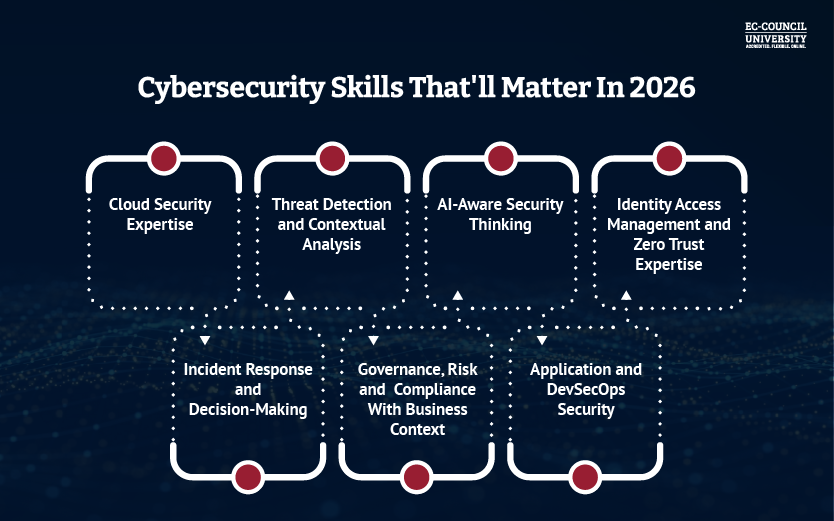
Top Cybersecurity Skills That Matter to Succeed in 2026 and Beyond
Cybersecurity skills you need in the modern era of the security threat landscape:
1. Cloud Security Is Critical
Cloud security remains one of the most in-demand domains. In today’s US job market, cloud security knowledge and skills are default requirements.
What stands out is:
- AWS, Azure, or GCP security fundamentals
- Understanding Cloud workload and configuration security
- Securing SaaS, APIs, and cloud workloads
Cloud security skills are no longer a specialization; it’s a foundation.
2. SIEM, Threat Detection & Contextual Analysis
Modern SIEM platforms are no longer log collectors, and SIEM skills are not just limited to monitoring logs.
High-impact security professionals are expected to know about:
- Event correlation and contextual analysis
- Threat hunting and real-time detection
- Incident triage and response workflows
Professionals are expected to:
- Correlate signals across clouds, endpoints, identities, and networks
- Reduce alert fatigue by prioritizing risk
- Turn detection into an actionable response
In the US SOC environment, signal-to-noise ratio is a business metric—not just a technical one.
3. AI-Aware Cybersecurity Thinking
You don’t need to build AI models, but you must understand them. The most valuable professionals aren’t those who blindly trust AI alerts. They are the ones who:
- Understand how AI-driven alerts are generated
- Validate and tune automated detections
- Understand AI limitations and question false positives intelligently
This is where experience beats tools.
4. Zero Trust & Identity Security
In US enterprises, identity security failures are board-level concerns. Identity is now the most targeted attack vector. For these reasons, Identity has become a new security perimeter.
Skills that matter include:
- IAM, MFA, and privileged access management
- Identity-based attack detection
- Securing remote and hybrid workforces
- Aligning access controls with real-world user behavior
5. Incident Response & Decision-Making Under Pressure
When incidents occur, speed and clarity matter. Organizations need professionals who can:
- Assess impact quickly
- Coordinate across legal, IT, and leadership
- Do a root cause analysis
- Make decisions with strong containment and recovery strategies
- Conduct regulatory and legal response coordination
These skillsets separate technicians from leaders.
6. Governance, Risk & Compliance (GRC) With Business Context
In the US regulatory landscape, compliance is a mandatory requirement. While knowing frameworks like ISO 27001, SOC 2, and GDPR is essential, modern GRC professionals need to be strategic and understand:
- How frameworks map to real risk
- How to communicate risk to non-technical stakeholders
- How to align security controls with business outcomes
This is where cybersecurity earns its seat at the table.
7. Application & DevSecOps Security
Security is no longer a final checkpoint—it’s embedded throughout the software development lifecycle. As organizations accelerate cloud-native development, security must shift left and integrate seamlessly with engineering workflows.
Modern AppSec and DevSecOps specialists should have the expertise to:
- Secure CI/CD pipelines from code to deployment
- Protect containers and Kubernetes environments at scale
- Enforce secure coding practices and continuous application monitoring
If done right, DevSecOps enables speed without sacrificing security, which is crucial today.
Why Soft Skills Matter More Than Ever in Cybersecurity
Cybersecurity success today is about informed decision-making, not just hands-on work with tools.
The best cybersecurity professionals today are the ones who can:
- Explain security risk in plain language
- Translate technical risks into business impact
- Communicate clearly with leadership and stakeholders
- Think critically during high-pressure incidents
- Influence decisions without fear
- Bridge the gap between SOC data and executive action
In most organizations, especially in the US, clarity drives cybersecurity funding.
Today, Certifications and Degrees Matter—But They’re Not the Differentiator Anymore.
Credentials help, especially early in a career.
But hiring managers increasingly look for:
- Hands-on experience with real tools
- Scenario-based problem solving
- The ability to think beyond playbooks
Credentials open doors to opportunities, but skills and experience combined bring accurate judgment, which is crucial in times of cyberattacks. The combination of expertise can only be achieved through programs that focus on real-world skills, knowledge building, and practical hands-on experience.
Global cybersecurity Institutes such as EC-Council University offer programs that make you job-ready with real skills through hands-on learning.
Cybersecurity Careers Aren’t Shrinking—They’re Evolving and Diversifying
The US cybersecurity workforce is expanding into roles like:
- Threat hunters and detection engineers
- Cloud and identity security specialists
- GRC and risk strategists
- Security product, architecture, and more specialized roles
Cybersecurity is no longer a single career path—it’s become an entire ecosystem.
And The Bottom Line Is Cybersecurity Isn’t Dying—It’s Growing at a Fast Pace.
Cybersecurity today looks different from it did five years ago—and that’s exactly the point.
The industry doesn’t need more tools. It needs people who understand risk, context, and impact.
For professionals willing to evolve and for organizations willing to invest in real capability, cybersecurity remains one of the most resilient, relevant, and future-proof domains in technology.
The next generation of cybersecurity success won’t be defined by how many alerts you generate—but by how clearly you understand what matters and why.
And that’s a skill no machine can replace.