
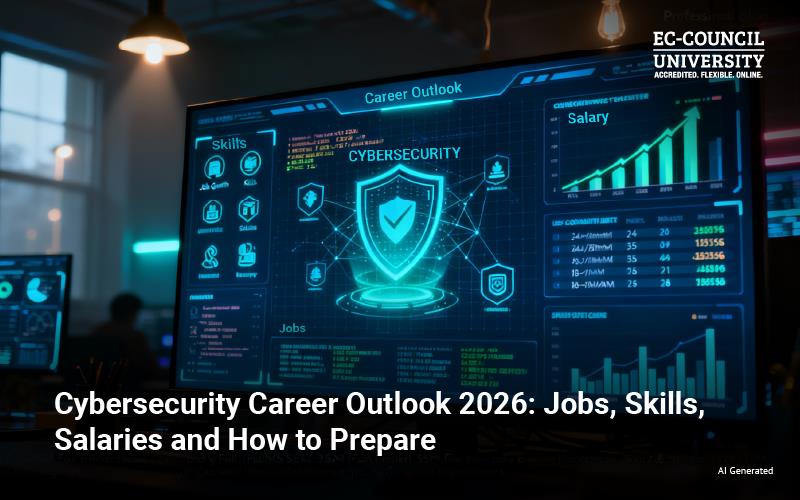
Cybersecurity in 2026: The Future That's Already Taking Shape!
Picture this: It’s early 2026, and the digital world is highly advanced. Businesses aren’t just “online” anymore; they are now fully automated, cloud-native, AI-powered, and interconnected in ways we once only imagined. Every process, every device, and every user’s action leaves a trail of data that needs protection.
Somewhere in this rapid shift, cybersecurity became the core of modern operations. It became an integral part of modern operations and not just an add-on support function. Companies rebuilt systems, governments tightened regulations, and the demand for skilled cyber professionals surged. The industry didn’t just grow; it evolved, rapidly and relentlessly, and with that evolution came an explosion in demand for cybersecurity talent.
If you are exploring a career in cybersecurity, know that you are stepping into an industry in the middle of its biggest evolution, loaded with opportunities, new specialties, and long-term growth. New threats, technologies, and new expectations are reshaping what cybersecurity careers will look like, creating opportunities that didn’t even exist a few years ago.
Here’s what 2026 and beyond have in store for aspiring and current cybersecurity professionals.
The Current State of Cybersecurity (2024–2025 Snapshot)
Cybersecurity is at a turning point, wherein, over the last two years, three major trends have shaped the industry:
1. New Technology Innovation
AI, IoT, edge computing, autonomous systems, and smart infrastructure have seen a surge in adoption between 2024 and 2025. While these technologies bring efficiency and innovation, they also introduce complex security challenges. AI-powered systems can be manipulated, IoT devices often lack proper safeguards, and autonomous technologies require entirely new security frameworks.
This wave of innovation has pushed the cybersecurity industry to evolve faster than ever, creating new job roles, specializations, and opportunities for skilled professionals.
2. Growing Cybercrime
Cyberattacks have reached record levels, with ransomware, phishing, deepfake scams, and nation-state threats continuing to escalate. Businesses have no choice but to increase security spending.
3. Massive Skills Shortage
There is a global shortage of millions of cybersecurity professionals. Organizations want more talent but struggle to find enough qualified candidates, creating a massive demand and supply gap, and an increased job opportunity in the industry.
4. Transformation Across Industries
Every sector, from healthcare to finance, manufacturing, government, and retail, is undergoing rapid digitalization, which is increasing the need for cybersecurity expertise.
These trends set the stage for strong career growth heading into 2026.
Why Cybersecurity Careers Will See Major Growth in 2026?
Cybersecurity in 2026 Will Practically Be Recession-Proof!
If the last few years taught us anything, it’s that cyber threats are not slowing down—not for pandemics, not for economic shifts, not for geopolitical chaos.
By 2026, analysts predict the global cybercrime costs to reach trillion dollars annually. As businesses increasingly rely on cloud ecosystems, AI-driven operations, and hyper-connected devices, the attack surface expands faster than companies can secure it.
This only means increased opportunities for cybersecurity professionals, with growing demands for more specialized roles, strategic skills, and strong visionary leadership.
- The global spending on cybersecurity products and services is projected to exceed $520 billion annually (USD) by 2026.- Cybercrime Magazine
- The global cybercrime is projected to cost $11.9 trillion by 2026.– Proxyrack
- AI is expanding the total addressable market (TAM) for cybersecurity providers to $2 trillion USD. – Cybercrime Magazine
The Tech Trends Shaping Cybersecurity Careers in 2026
1. AI-Driven Cyber Threats (and Defenses)
AI is not just a technology that assists in defense, but also a double-edged sword that enables attackers to execute an attack. Autonomous malware, intelligent phishing, and deep-fake-powered social engineering will force cybersecurity to become smarter than ever.
Career roles that will boom:
- AI Security Specialist
- Machine Learning Threat Analyst
- Adversarial AI Researcher
2. Zero Trust Goes from Trend to Default
“Never trust, always verify” won’t be a buzzword in 2026—it will be mandatory architecture for organizations of all sizes, especially in the U.S., where federal mandates push Zero Trust adoption.
In-demand roles:
- Zero Trust Architect
- Identity & Access Management (IAM) Engineer
- Network Segmentation Specialist
3. Cloud Security Skills Become Non-Negotiable
By 2026, the majority of global workloads will live in multi-cloud and hybrid environments. Misconfigurations will still be a top cause of breaches—meaning cloud security pros will remain the heroes companies plead for.
Hot roles:
- Cloud Security Engineer
- DevSecOps Specialist
- Cloud Governance & Compliance Analyst
4. Quantum Computing Threats Begin to Emerge
Although quantum computing may not be fully deployed by 2026, but the race to secure data before quantum attacks become feasible will intensify.
Future-ready roles:
- Post-Quantum Cryptography Specialist
- Encryption & Key Management Analyst
5. OT & IoT Security Explodes
From smart homes to smart grids, everything is connected, and therefore, everything is vulnerable. Critical infrastructure protection becomes a top-tier priority in the U.S.
Growing roles:
- OT Security Engineer
- IoT Security Analyst
- Industrial SOC Analyst
6. Privacy Regulations Tighten
New data laws, stricter compliance standards, and global privacy frameworks will reshape how companies collect and protect data.
Rising roles:
- Cybersecurity Compliance Specialist
- Data Privacy Analyst
- Governance, Risk & Compliance (GRC) Manager
7. Cybersecurity Needs Soft Skills More Than Ever
Automation will handle repetitive tasks—but it can’t replace human judgment, communication, or leadership. Cyber professionals who can explain risks, present findings, and strategize will outrank those who only know tools.
Career Outlook: What Cybersecurity Professionals Can Expect in 2026
Top Cybersecurity Jobs to Watch Out for in 2026
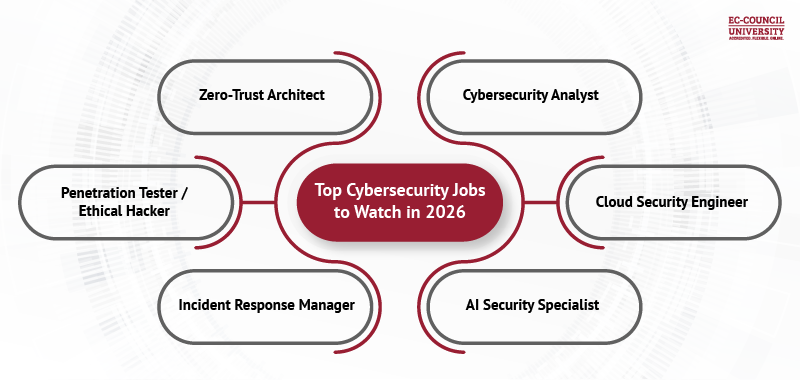
The global cybersecurity talent gap is unlikely to close anytime soon, especially in the U.S., which will continue to face hundreds of thousands of unfilled roles.
If you have the skills, you’ll have immense opportunities to explore. Here are the roles expected to see the most growth over the next two years:
1. Cybersecurity Analyst
The backbone of security teams who monitor threats, manage alerts, perform risk assessments, and perform other critical security tasks.
2. Cloud Security Engineer
As cloud adoption accelerates, securing cloud infrastructure becomes a top priority, and so will the demand for Cloud Security Engineers increase.
3. AI Security Specialist
The increased adoption of AI across industries will lead to a growing demand for AI security specialists. These professionals protect AI systems from manipulation, data poisoning, and model theft.
4. Incident Response Manager
When breaches happen, these experts lead the recovery process and minimize damage. This reflects the essential role it plays and will continue to play in the years to come.
5. Penetration Tester / Ethical Hacker
Companies rely on ethical hackers to uncover vulnerabilities before attackers do. With the increasing number of cybercrimes, there will be a continued demand for ethical hackers and penetration testers in the industry.
6. OT (Operational Technology) Security Expert
Today, critical infrastructure across sectors need specialists who understand systems and the security aspects of different technologies. So, in the coming years, the demand for such specialists will only grow, opening doors of opportunities for specialists.
7. Zero-Trust Architect
As perimeter security becomes outdated, zero-trust frameworks will dominate, requiring the need for zero-trust architects in the coming years.
These cybersecurity careers offer excellent long-term growth and stability in 2026 and beyond.
In-Demand Cybersecurity Skills and Credential In 2026
Organizations will prioritize:
- Practical skills
- Hands-on Experience
- Industry-recognized credentials
- Portfolio that demonstrates your skills
So, for professionals to thrive in cybersecurity in 2026, they should consider building a mix of technical and soft skills, earn the right credentials, and maintain a strong portfolio.
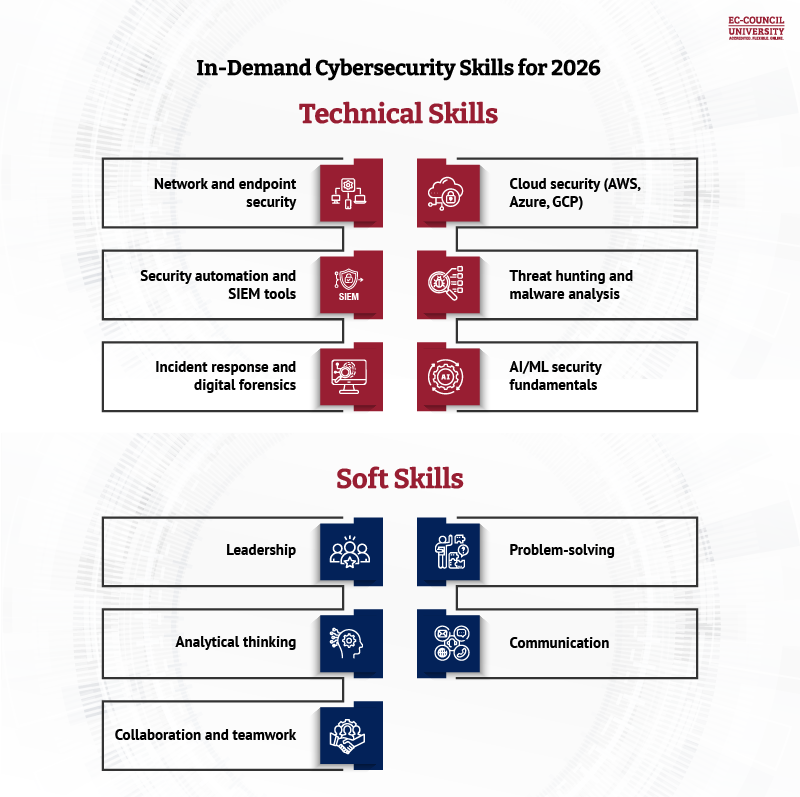
Technical Skills
|
|
Soft Skills
|
|
Key Certifications
|
|
These skills and credentials will significantly improve employability.
Salary Outlook for Cybersecurity Roles in 2026
What to Expect: Summary of Cybersecurity Salary Outlook in 2026
| Career Stage | Typical U.S. Salary Range (2026) |
| Entry-Level | ~$74K–$110K |
| Mid-Level | ~$115K–$212K |
| Senior/Specialist | ~$154K–$280K+ |
| CISO/Executive | ~$220K–$420K+ |
Salaries may vary significantly by location, company size, sector, and certifications, with executive and highly specialized technical roles earning the highest compensation.
With demand exceeding supply, salaries for cybersecurity roles are expected to continue the upward climb. AI security, cloud security, and specialized threat intel roles will command some of the highest increases.
How to Prepare Now for a Cybersecurity Career in 2026
Here’s your roadmap to prepare for a successful cybersecurity career in 2026:
1. Build a Strong Foundation
Learn:
|
|
2. Get Hands-On Experience
Gain hands-on experience and real-world exposure using tools, labs, and participating in cyber events
|
|
3. Earn Relevant Certifications
|
|
4. Build a Portfolio That Speaks for You
Proof speaks louder than resumes—projects, labs, write-ups, certifications. So, document reports, security solutions, write-ups, and screenshots of labs, etc. Employers love proof. Upload your portfolio to:
|
|
5. Cybersecurity Career Paths for Jobs in 2026
|
|
How to Advance Your Cybersecurity Careers in 2026 with ECCU?
The key to career advancement and success in 2026 is to upskill and stay current with the latest trends and technologies that impact the cybersecurity industry. This includes focused learning and upskilling in cloud security and architecture, AI-driven threats and growing regulatory demands.
EC-Council University (ECCU) provides a clear pathway for career advancement by combining industry-aligned education with globally recognized certifications that prepare you for real-world jobs.
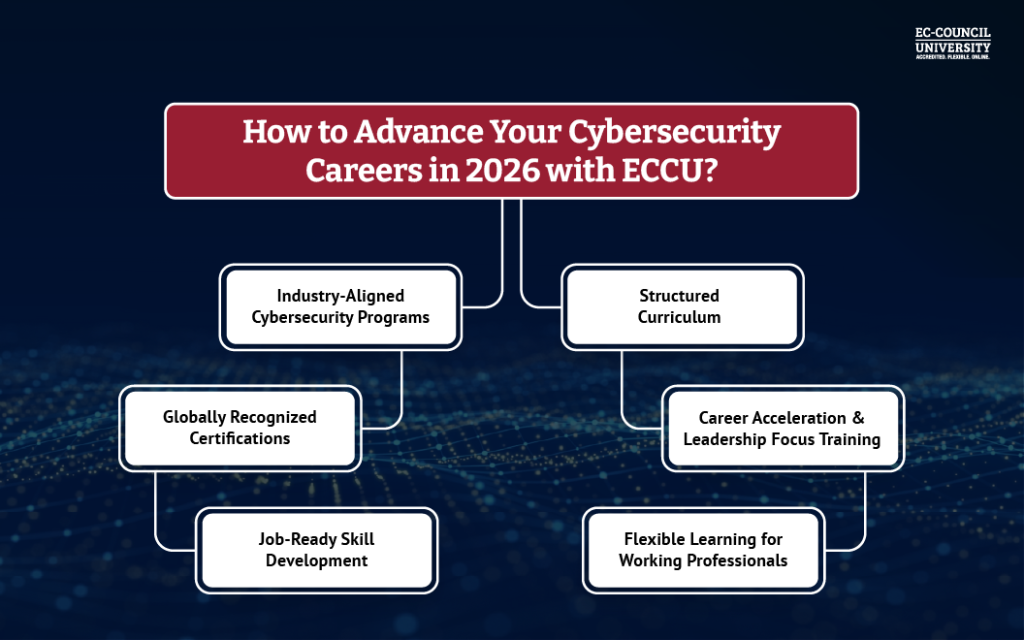
1. Industry-Aligned Programs
Earn internationally recognized degrees that are valued across industries and regions globally.
- Bachelor of Science in Cybersecurity
A foundational degree that teaches you the core skills of cybersecurity—networking, security tools, threat detection, and defense strategies. Perfect for launching your cybersecurity career. - Master of Science in Cybersecurity
An advanced, technical degree that helps you deepen your expertise in areas like cloud security, digital forensics, ethical hacking, and advanced threat analysis. Ideal for moving into specialized or senior technical roles. - MBA in Cybersecurity
A leadership-focused degree combining business strategy with cybersecurity management. Designed for professionals aiming for managerial, executive, or strategic roles in security, risk, and governance. - Graduate Certificate Program
A short, focused program that helps you quickly build skills in a specific cybersecurity area—like cloud security, digital forensics, GRC, or ethical hacking. Great for upskilling without committing to a full-time degree.
The goal is simple; choose the path that matches your ambition and get job-ready for 2026 most in-demand cybersecurity careers.
2. Structured Curriculum
- Learn from programs that are mapped to real-world cybersecurity roles and current threat landscapes.
- Gain knowledge of key domains like ethical hacking, cloud security, digital forensics, GRC, network defense, and more.
3. Globally Recognized Certifications
- Earn academic degrees and globally recognized credentials simultaneously. (Earn e.g., EC-Council certifications CEH, CHFI, CND, CCISO)
4. Career Acceleration & Leadership Focused Training
- Prepare for advanced technical and leadership roles with learnings that focus on security strategy, decision-making, risk management, and governance, designed for senior-level positions.
5. Job-Ready Skill Development
- Focus on emerging technologies, AI-driven threats, and evolving compliance requirements.
- Helps professionals remain competitive in the 2026 cybersecurity job market.
6. Flexible Learning for Working Professionals
- Fully online, flexible programs designed to fit around full-time jobs
- Supports continuous upskilling without career disruption
Take the Next Step!
Get a personalized career roadmap and expert guidance on selecting the right program, certifications, and learning path to accelerate your cybersecurity career.
Cybersecurity Career Boom: What 2026 Holds for You
2026 isn’t far away, but the cybersecurity landscape is evolving rapidly.
The good news? Every new technology, every new regulation, and every new threat creates new career opportunities.
If you are curious, analytical, and excited about solving digital mysteries, the cybersecurity industry welcomes you with open arms and endless growth potential.
In the cybersecurity industry:
- The demand is here.
- The growth is here.
- The opportunity is yours.
Ready to dive in and make the most of this opportunity?