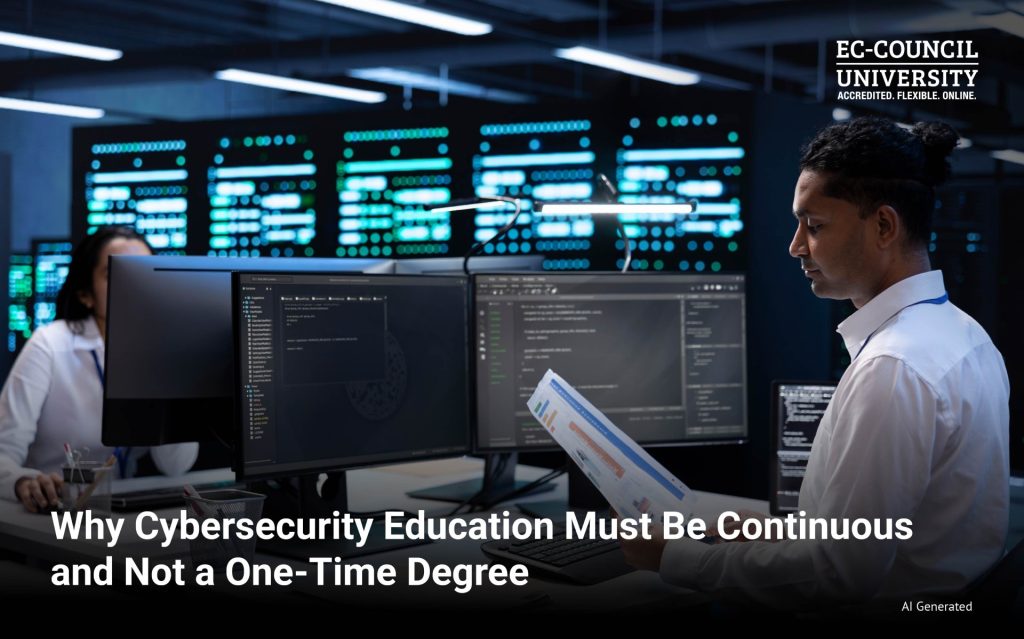
Why Cybersecurity Demands a Continuous Learning Mindset
We’ve been told for decades that the go-to educational blueprint is to earn a degree, enter the workforce, and rely on that foundational knowledge throughout your career. This may still hold true in more static disciplines, but it’s dangerously outdated in cybersecurity. Cybersecurity is not a fixed body of knowledge. It is a living, evolving discipline shaped by adversaries who innovate relentlessly. New attack vectors emerge daily, while technologies such as AI and quantum computing are transforming the threat landscape. In this environment, yesterday’s expertise can quickly become today’s vulnerability.
These conditions make it clear that cybersecurity education cannot be a one-time milestone, especially for leadership positions. It must be a continuous, career-long commitment. Professionals who fail to evolve risk becoming redundant. On the other hand, those who embrace lifelong learning are likely to find themselves at the forefront of one of the most dynamic and consequential fields of our time.
The Growing Scale of Cyber Threats
The growth rate of cyber threats is accelerating at breakneck speed, requiring cybersecurity professionals to constantly keep up. Consider this:
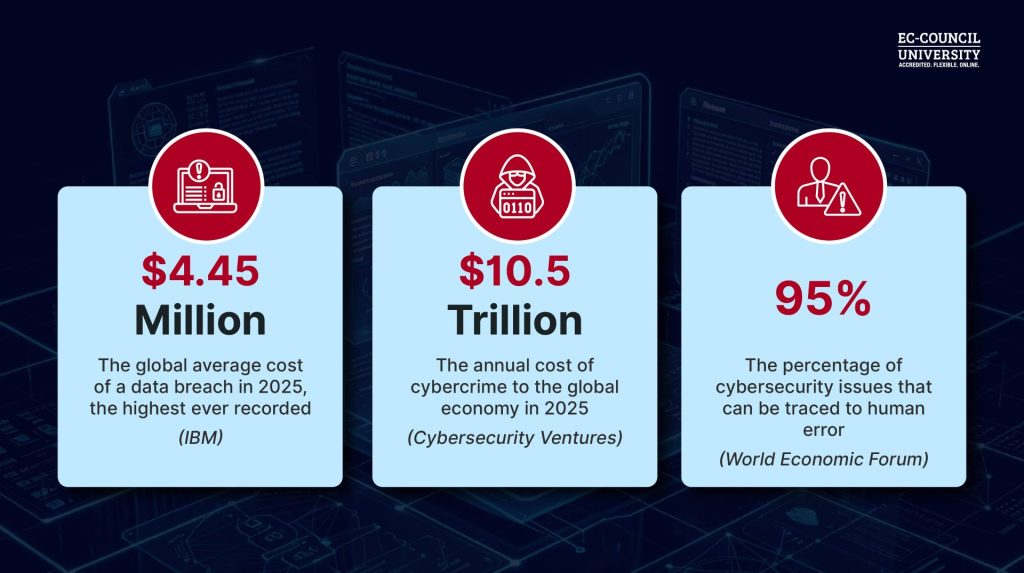
These figures underscore why cybersecurity knowledge and skills can’t be allowed to stagnate in such a dynamic threat environment.
Why a One-Time Cybersecurity Degree Is No Longer Enough
Yes, a traditional degree provides a good foundation, but foundations alone are insufficient in cybersecurity. Most academic programs, by necessity, operate on structured timelines. Curricula are designed, approved, and delivered over months or years. Meanwhile, the cybersecurity landscape evolves in real time. New vulnerabilities are discovered, threat actors refine their tactics, and technologies shift faster than academic cycles can adapt.
As a result, professionals who rely solely on their initial degree often find themselves outpaced by both adversaries and peers. The gap between what was learned and what is required widens over time, unless it is actively closed through continuous education.
Therefore, cybersecurity professionals must continuously earn and maintain their relevance.
The Talent Shortage Problem in Cybersecurity
A persistent and widening skills gap further amplifies the urgency of continuous learning.
- There’s a global shortage of over 4.5 million cybersecurity professionals.
- Organizations increasingly prioritize hands-on expertise and current certifications over static or outdated credentials.
- Cybersecurity roles are among the most difficult to fill globally, with demand far outpacing supply.
These factors have created both a challenge and an opportunity. Employers are not merely seeking degree holders, but rather qualified practitioners who demonstrate current, applied knowledge. Continuous learners distinguish themselves by staying aligned with industry needs, making them more employable, adaptable, and valuable.
What Continuous Learning in Cybersecurity Education Looks Like
When it comes to cybersecurity education, continuous learning should be treated as a multidimensional strategy that encompasses:
- Ongoing Certifications: Certifications validate current expertise and signal commitment to professional growth. They also evolve alongside industry standards, ensuring relevance.
- Hands-On Practice: Cybersecurity is inherently practical. Virtual lab simulations, capture-the-flag (CTF) exercises, and real-world scenarios are essential for skill retention and application.
- Microlearning and Modular Education: Short, focused learning modules allow professionals to acquire new skills without career interruptions. This approach aligns with the rapid pace of technological change.
- Industry Updates: Staying informed through threat intelligence reports, cybersecurity blogs, and networking in professional communities is critical. Awareness is the first line of defense.
- Cross-Domain Learning: Cybersecurity increasingly intersects with domains such as AI, cloud computing, and regulatory compliance. Broadening one’s expertise enhances strategic thinking, problem-solving, and leadership skills.
How ECCU Enables Continuous Learning in Cybersecurity
EC-Council University (ECCU) recognizes that cybersecurity education must extend beyond traditional boundaries. That’s why:
- We integrate academic rigor with industry relevance, ensuring that learning remains aligned with real-world demands.
- Our programs and courses are designed to evolve, incorporating emerging technologies and threat trends into the curriculum.
- Our online, asynchronous learning model enables professionals to continuously upskill even while working full-time.
- We integrate industry-recognized certifications into degree curricula to bridge the gap between theory and practice, ensuring graduates are both knowledgeable and job-ready.
- We provide our students with unrestricted access to virtual labs where they get hands-on practice using cutting-edge cybersecurity tools in environments that mimic real-world scenarios.
This proactive and forward-thinking approach to cybersecurity education embraces lifelong learning as a strategic cornerstone.
The Role of Cybersecurity Certifications in Continuous Learning
Cybersecurity certifications serve as critical milestones in a continuous learning journey by providing:
- Validation of current skills
- Alignment with industry standards
- Structured pathways for specialization
Unlike traditional static degrees, certifications require routine renewal, ensuring professionals stay up to date with current cybersecurity requirements.
How Continuous Learning Impacts Career Growth in Cybersecurity
Continuous learning can have a transformative effect on career success. Professionals who invest in ongoing education:
- Advance more quickly into leadership roles
- Adapt to new technologies and responsibilities
- Command higher salaries due to specialized expertise
- Contribute more strategically to organizational security
In contrast, those who remain stationary often find their roles diminished over time as automation and evolving threats outpace their skills.
Areas That Require Continuous Cybersecurity Education
The following domains will have a strong influence on future cybersecurity practices:
- Cloud Security: As more organizations migrate to cloud environments, securing distributed infrastructures becomes paramount.
- AI & Machine Learning in Cybersecurity: AI is both a tool and a threat. Understanding its applications in threat detection and adversarial attacks is essential.
- Zero Trust Architecture: The shift from perimeter-based security to identity-centric models requires new frameworks and skills.
- Robotics: Compromised robotic systems can cause both digital and physical damage, so ensuring their security is of significant importance.
- Governance, Risk & Compliance (GRC): Regulatory landscapes are becoming more complex, requiring professionals to navigate legal and ethical considerations alongside technical ones.
Each of these areas requires cybersecurity professionals to adopt a continuous learning mindset to remain effective.
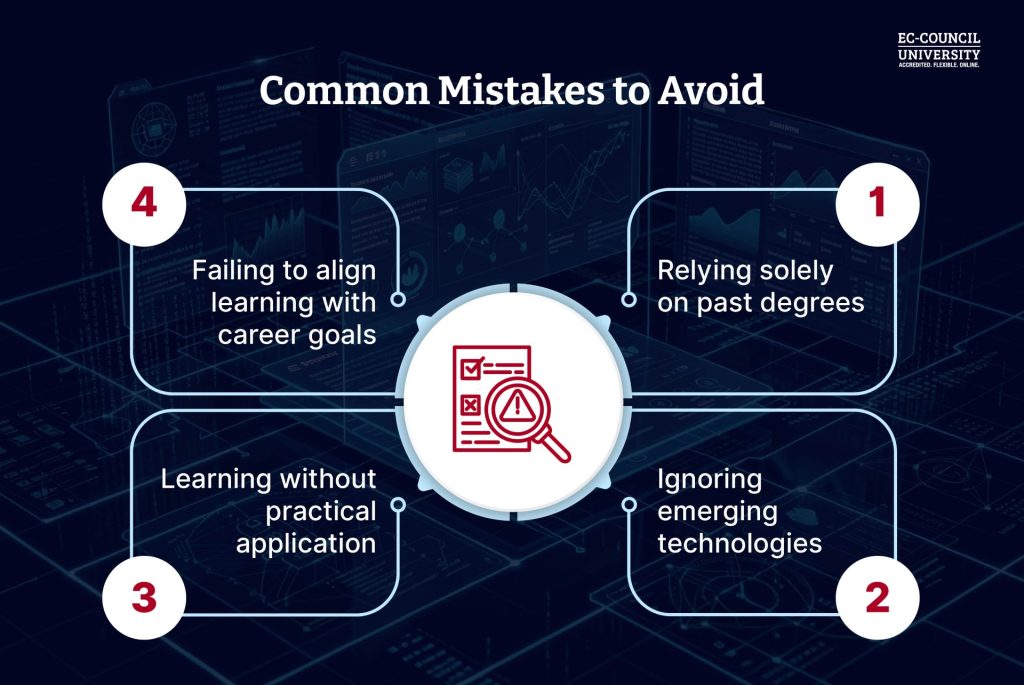
Do’s and Don’ts of a Good Continuous Learning Strategy
Essential aspects of a reliable continuous learning strategy include:
- Setting clear career goals: Identify the roles and domains you want to pursue
- Creating a learning roadmap: Combine certifications, courses, and practical experiences
- Allocating time consistently: Treat learning as a non-negotiable professional responsibility
- Engaging with the community: Participate in forums, conferences, and peer networks
- Measuring progress: Regularly assess your skills and adjust your strategy
The Future of Cybersecurity Education
Cybersecurity education is undergoing a fundamental transformation.
- Lifelong learning models will replace one-time degrees
- Modular and stackable credentials will allow for flexible, personalized pathways
- AI-driven learning platforms will deliver adaptive, real-time education
- Simulation-based training will replicate real-world cyber environments
Education will no longer be a phase, but rather a continuous process ingrained throughout one’s career.
In Summary
The professionals who will shape the future of cybersecurity are not those who learned the most at a single point in time, but those who commit to continuous learning and recognize that developing expertise is an ongoing process.
Invest in continuous learning. In doing so, you protect your career while also contributing meaningfully to securing the digital world.
EC-Council University (ECCU) embodies the essence of continuous learning by offering cybersecurity education that evolves alongside the industry. Our online degrees and courses are designed to be flexible, relevant, and aligned with the latest industry requirements. Discover more about the learning experience at ECCU:
Frequently Asked Questions (FAQs)
Cyber threats evolve rapidly, making it essential for professionals to update their skills regularly to remain effective.
Ideally, learning should be ongoing, with regular updates through certifications, courses, and hands-on practice.
Cybersecurity certifications validate current, practical, and in-demand skills, making them critical in a fast-changing field.
Cybersecurity professionals with relevant, up-to-date skills and industry-aligned certifications often command higher salaries and attract better job opportunities.
Yes, flexible online programs enable professionals to learn without interrupting their careers.
Start with foundational knowledge, set clear goals, and commit to regular upskilling through structured learning paths.