What is Public Speaking Anxiety?
Public speaking anxiety is one of the most common fears in the professional world. It affects entry-level analysts, mid-level managers, and even senior executives. Rather than the fear disappearing with experience, it tends to become stronger as responsibility increases. Imagine presenting a cybersecurity risk assessment to executive leadership. You understand the data and know the mitigation strategy. Yet as you stand up to speak, your heart rate accelerates, you become self-conscious and nervous, and your thoughts feel scattered. This isn’t incompetence. It’s biology.
Public speaking anxiety is a psychological and physiological response that occurs when individuals speak in front of an audience and perceive judgment or evaluation. When this happens, the brain activates the fight-or-flight system. Adrenaline is released, the heart rate increases, muscles tense, and cognitive processing speeds up. Research in behavioral psychology consistently identifies speaking in front of an audience as one of the top workplace anxieties, often ranking higher than financial stress or job interviews.
In today’s environment, strong public speaking skills are directly connected to career growth. Whether you are leading a cybersecurity incident response briefing, presenting quarterly metrics, defending a budget proposal, or speaking at a conference, your ability to communicate clearly influences trust, authority, and leadership perception. The good news is that public speaking anxiety can be managed and even harnessed into performance energy.
This article outlines 10 proven techniques to overcome public speaking anxiety that work in real professional settings, particularly in high-accountability fields such as cybersecurity.
Public Speaking Anxiety is Greater in Cybersecurity and Leadership Roles
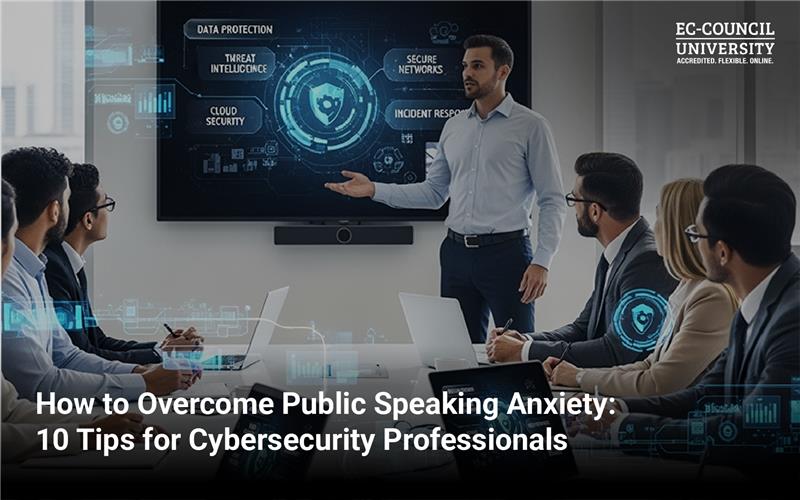
Before exploring tips to address public speaking anxiety, let’s understand why public speaking is important for cybersecurity professionals. Presentations carry consequences in high-stakes industries like cybersecurity. A cybersecurity analyst presenting vulnerability findings is influencing risk mitigation decisions. A security manager defending budget allocations is influencing investment priorities. A CISO addressing a breach is shaping organizational trust. The higher the accountability, the higher the perceived evaluation.
Communication expectations increase significantly as professionals move into advanced roles. That’s why EC-Council University’s online master’s degrees, such as the Master of Science in Cyber Security, impart business communication skills alongside technical expertise. Presenting governance frameworks, risk assessments, and mitigation strategies requires disciplined articulation.
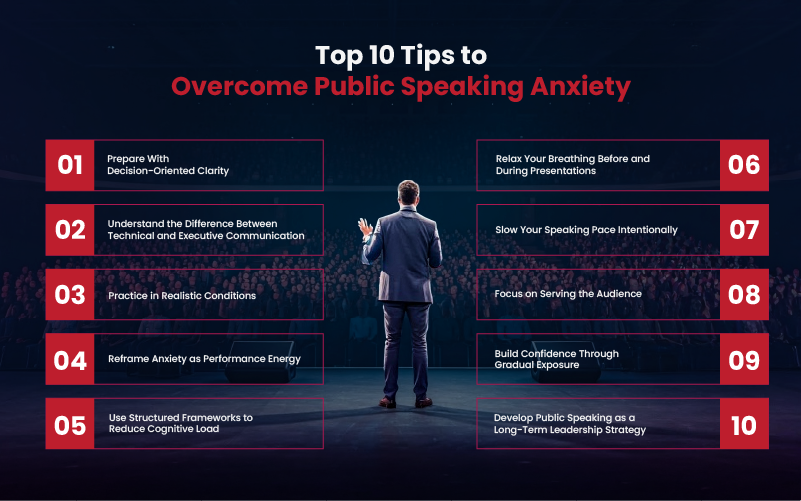
Top 10 Tips to Overcome Public Speaking Anxiety
Now, let’s dive into valuable techniques cybersecurity professionals can rely on to overcome public speaking anxiety:
1. Prepare With Decision-Oriented Clarity
Uncertainty fuels anxiety, and preparation reduces uncertainty. However, effective preparation is not about memorizing slides. It is about clarifying intent. Before any presentation, ask yourself:
- What decision am I trying to get the audience to make?
- Why does this issue matter to them?
- What business outcome is affected?
In cybersecurity environments, executives are focused on financial impact, operational disruption, regulatory exposure, and reputation risk. Structuring your presentation around these priorities builds confidence because the message becomes purposeful.
2. Understand the Difference Between Technical and Executive Communication
A leading source of public-speaking anxiety for cybersecurity professionals is mismatched audiences. Technical audiences expect stats and data, while executive audiences value clarity.
| Technical Communication | Executive Communication |
| Vulnerability details | Business risk summary |
| Tool configuration | Financial exposure |
| Metrics and logs | Strategic recommendation |
| Implementation steps | Decision guidance |
Anxiety decreases when expectations are clear. Professionals who pursue leadership-focused degrees, such as ECCU’s MBA in Cyber Security, can refine their ability to shift fluidly between these communication styles.
3. Practice in Realistic Conditions
Silent rehearsal is often insufficient. It’s better to speak your presentation aloud, stand while speaking, use your slides, and time yourself.
Recording your delivery allows you to identify pacing issues and unclear transitions. Practicing in realistic conditions trains your brain to associate public speaking with familiarity rather than fear.
4. Reframe Anxiety as Performance Energy
The physical sensations of anxiety and excitement are nearly identical. Rapid heartbeat and heightened alertness can signal fear or readiness, depending on interpretation.
Instead of telling yourself that you are nervous, remind yourself that your body is preparing you to perform. High-performing business leaders are experts at using an adrenaline rush to their benefit.
5. Use Structured Frameworks to Reduce Cognitive Load
Unstructured presentations increase stress because the brain must manage both content recall and delivery simultaneously. Adopt this simple structure while preparing your presentation:
- Explain the current situation
- Define its business impact
- Put forth your recommended action
- State the expected outcome of your recommendation
When structure is predictable, mental bandwidth is freed for confident delivery.
6. Relax Your Breathing Before and During Presentations
Breathing directly influences the nervous system. A slow inhalation followed by a longer exhalation signals safety to the brain and reduces stress activation.
Before speaking, inhale slowly through your nose, pause briefly, and exhale fully. Repeat this cycle several times. During your presentation, pause between key points to regulate breathing. A calm body supports a steady voice.
7. Slow Your Speaking Pace Intentionally
Anxiety often accelerates speech, which reduces clarity and increases mistakes. Consciously slow down, pause between ideas, and allow silence to reinforce key messages.
Measured speech pacing communicates confidence and authority.
8. Focus on Serving the Audience
Self-focus amplifies anxiety, while focusing on the audience reduces it.
Ask yourself how your presentation benefits the listeners. What clarity are you providing? What risk are you helping them understand? And what decision are you asking them to make?
Leadership communication is about service, not perfection in performance.
9. Build Confidence Through Gradual Exposure
You reinforce fear by avoiding public speaking. On the other hand, gradually engaging in public speaking reduces fear. Start by leading short internal updates, volunteering to present project summaries, and participating actively in discussions.
Targeted professional development offered in ECCU’s Cybersecurity Graduate Certificate Programs includes peer-to-peer discussions and presentation exercises that mirror real workplace scenarios.
10. Develop Public Speaking as a Long-Term Leadership Strategy
Public speaking is not a one-time skill. It’s a long-term leadership competency. As professionals move up the corporate hierarchy, their responsibilities shift from technical execution to strategic influence. Explaining compliance frameworks, justifying cybersecurity investments, and guiding crisis communication require disciplined articulation.
Remember, technical mastery builds expertise, while communication mastery builds authority.
Common Public Speaking Mistakes Professionals Make
Try to avoid these mistakes when making presentations or giving public speeches:
- Speaking too quickly
- Overloading slides with data
- Failing to connect technical risk to business impact
- Reading directly from slides
- Apologizing excessively for minor errors
“If you can’t communicate and talk to other people and get across your ideas, you’re giving up your potential.”
– WARREN BUFFETT
The Career Impact of Overcoming Public Speaking Anxiety
Strong public speaking skills give you the following career advantages:
- Leadership visibility
- Executive trust
- Promotion readiness
- Stakeholder confidence
- Compensation growth
In cybersecurity, the ability to explain risk clearly often determines whether initiatives receive funding and executive support.
Elevate Your Public Speaking Skills Along with Your Technical Proficiency
Public speaking anxiety does not define leadership potential. It’s a natural reaction that can be overcome with preparation, structure, and disciplined practice. Professionals who advance into leadership positions are not fearless. They practice and prepare beforehand, understand their audience, and structure their message clearly. In high-stakes fields such as cybersecurity, the ability to communicate risk with clarity is a strategic advantage. When technical expertise is delivered with confidence and authority, it can influence anyone.
EC-Council University (ECCU) equips learners with both superior technical expertise and top-tier communication skills. To know more about the benefits of studying at ECCU:
Frequently Asked Questions
Yes, It affects professionals across industries and experience levels.
For most individuals, anxiety decreases significantly with preparation and repeated exposure. The goal is effective management rather than complete elimination.
With consistent practice over several months, noticeable improvement is common.
Yes. As roles become more strategic, communication expectations increase.