What Are Cybersecurity Certifications?
Cybersecurity remains one of the most critical and future-proof career paths available today. Whether you’re a seasoned cybersecurity professional looking to upskill or someone aspiring to transition into this field, cybersecurity certifications are potent tools that can validate your expertise, enhance your credibility, and open doors to faster career growth. Cybersecurity certifications are formal credentials awarded by reputable institutions to individuals who demonstrate mastery of specific cybersecurity knowledge areas and practical skills. Unlike traditional degrees, certifications prioritize hands-on competencies and typically require passing rigorous practical exams.
In this in-depth guide, we’ll explore why cybersecurity certifications matter in 2026, the benefits they unlock, and how to select the proper certifications to help you thrive in the booming cybersecurity industry.
Why Cybersecurity Certifications Are More Relevant Than Ever in 2026
In 2026, cybersecurity professionals face a reality shaped by explosive growth in digital connectivity and cybercrime:
- Global cost of cybercrime is staggering: It’s estimated to exceed $10.5 trillion annually, making cybercrime one of the world’s largest illicit industries.
- Data breach costs remain high: The average financial loss from a single breach was approximately $4.44 million in 2025 and significantly higher in the U.S. market.
- Talent shortages persist: Many organizations report severe skills gaps, especially in areas like cloud security and advanced defense, which leaves critical job roles unfilled.
- AI both helps and hurts: Cybercriminals are increasingly using AI to automate attacks, so defenders must understand AI’s strengths and risks.
These pressures make specialized cybersecurity skills highly sought after by employers across industries, and certifications are one of the most effective ways for professionals to acquire those skills.
10 Key Benefits of Obtaining Cybersecurity Certifications
Let’s unpack the tangible advantages of earning cybersecurity certifications in 2026 (with real-world scenarios that show why they matter).
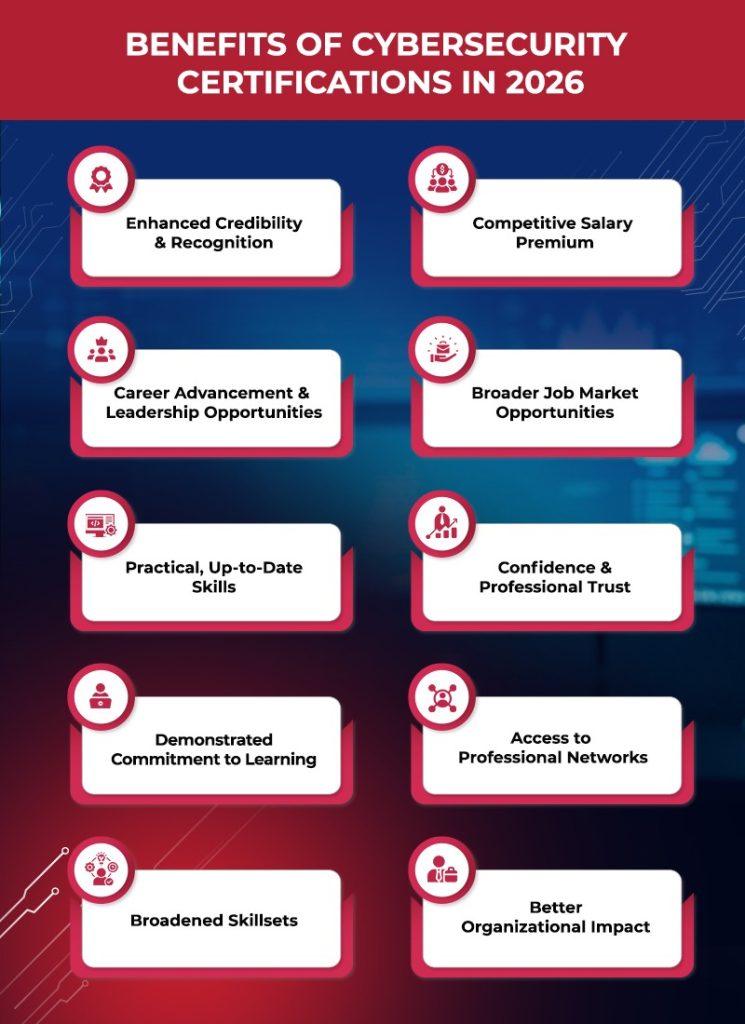
1. Enhanced Credibility and Recognition
Cybersecurity certifications from institutions like EC-Council University are universally recognized benchmarks of expertise. They prove to employers that you’re qualified and competent. They’re particularly important when employers vet candidates for high-stakes cybersecurity roles.
Scenario: A hiring manager choosing between two candidates for a Lead Penetration Tester role may favor the one who holds a relevant certification, such as CPENT (Certified Penetration Testing Professional).
2. Competitive Salary Premium
Certified professionals often earn higher salaries than their non-certified peers. Employers appreciate quantifiable skill validation, which can justify salary offers above the market average.
Scenario: A certified ethical hacker negotiates a 10–20% higher offer compared to non-certified applicants with similar work backgrounds.
3. Career Advancement and Leadership Opportunities
Cybersecurity certifications demonstrate a commitment to upskilling and developing new skills, helping professionals access leadership positions and specialized roles as they advance in their careers.
Scenario: The CCISO (Certified Chief Information Security Officer) certification can facilitate a transition from a mid-level SOC analyst to a management or executive leadership role as the individual gains experience and expertise.
4. Broader Job Market Opportunities
Certain employers and government contracts mandate specific certifications for technical cybersecurity roles. Without them, you won’t be eligible for the job.
Scenario: Federal cybersecurity jobs often list the CEH (Certified Ethical Hacker) certification as a requirement for related cybersecurity roles.
5. Practical, Up-to-Date Skills
Cybersecurity certifications keep you aligned with the latest threats, tools, and frameworks, moving far beyond textbook knowledge. This operational readiness is essential for today’s cyber professionals.
Scenario: When an AI-powered ransomware attack hits, professionals familiar with current threat patterns and countermeasures are more effective in response and mitigation efforts.
6. Confidence and Professional Trust
Cybersecurity certifications foster confidence and are often associated with higher levels of trust from peers, managers, and clients.
Scenario: A cybersecurity consultant with certified credentials is more likely to be entrusted with high-profile client engagements.
7. Demonstrated Commitment to Learning
Certifications signal to employers that you’re proactive and dedicated to professional growth. These qualities matter in a field that evolves daily.
Scenario: Cybersecurity applicants who possess certifications in addition to a degree have a competitive edge over those who rely solely on degree qualifications.
8. Access to Professional Networks
Certification courses often provide access to networking communities and international forums that extend your professional reach.
Scenario: Networking with fellow professionals in a cybersecurity certification course can lead to job referrals and collaborations.
9. Broadened Skillsets
With multiple certifications, you can enhance your professional aptitude to span more than one cybersecurity specialization.
Scenario: A cybersecurity analyst can become a specialized digital forensics expert by layering the CHFI (Computer Hacking Forensic Investigator) certification on top of existing qualifications.
10. Better Organizational Impact
Certified professionals are associated with implementing stronger cybersecurity practices within organizations, reducing risk exposure, and enhancing operational security effectiveness.
Scenario: An incident response team led by certified experts can respond to cyberattacks more quickly and efficiently than one without recognized credentials.
Prominent Cybersecurity Certifications from EC-Council University
EC-Council University (ECCU) offers some of the most in-demand globally recognized cybersecurity certifications that employers value. Here’s a selection of top certifications designed to prepare professionals for the cybersecurity landscape of 2026:
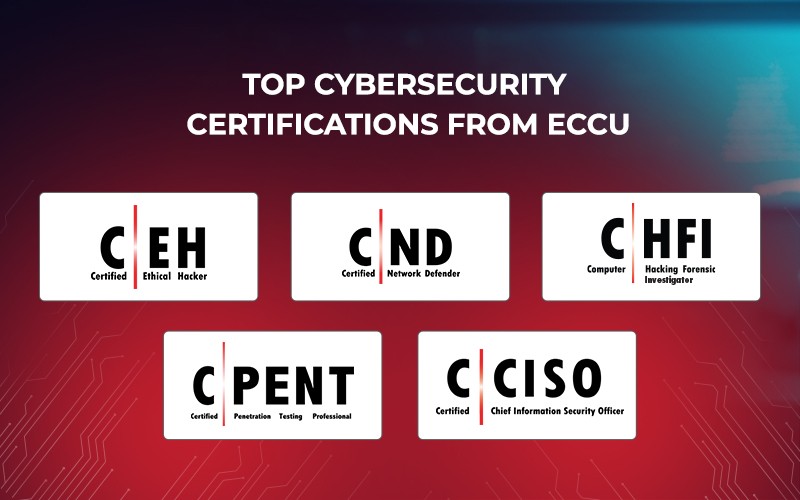
1. Certified Ethical Hacker (CEH)
- Expertise: Ethical hacking and penetration testing
- Core Skills: Vulnerability assessment, exploit techniques, usage of ethical hacking tools
- Ideal For: Aspiring penetration testers, ethical hackers, red team specialists
- Overview: CEH is acclaimed as a premier ethical hacking certification, validating your ability to think like a hacker and protect systems accordingly.
2. Certified Network Defender (CND)
- Expertise: Defensive network security
- Core Skills: Network architecture defense, intrusion detection, attack surface analysis
- Ideal For: Network defenders, cybersecurity analysts
- Overview: CND prepares professionals to secure networks and counter threats effectively, often in conjunction with ethical hacking training.
3. Certified Hacking Forensic Investigator (CHFI)
- Expertise: Digital forensics
- Core Skills: Evidence collection, forensic analysis, mobile device forensics
- Ideal For: Forensic analysts, forensic investigators
- Overview: CHFI certification holders excel at uncovering how breaches occurred and securing legal-grade evidence.
4. Certified Penetration Testing Professional (CPENT)
- Expertise: Advanced penetration testing
- Core Skills: Threat analysis, cross-system pentesting, OSINT methodology
- Ideal For: Advanced penetration testers, cybersecurity consultants
- Overview: CPENT goes beyond fundamentals, challenging professionals to exploit and defend against sophisticated cyberattacks.
5. Certified Chief Information Security Officer (CCISO)
- Expertise: Enterprise cybersecurity governance
- Core Skills: Risk management, information assurance, corporate governance
- Ideal For: Aspiring CISOs, CTOs, cybersecurity directors
- Overview: The CCISO certification offers leadership expertise to define strategies, set policies, and guide teams on how to protect organizations from cyber threats.
How to Choose Your Ideal Cybersecurity Certifications
Selecting the right certifications may feel challenging sometimes, so here’s a structured approach on how to go about it:
- Define Your Career Aspiration: Are you aiming for hands-on technical roles or strategy and leadership?
- Evaluate Your Experience: Entry-level certifications are perfect for newcomers, while advanced roles may require more specialized credentials or a mix of certifications, degrees, and experience.
- Research Market Demand: Look at job postings and industry demand. Certain roles consistently require specific certifications.
- Align With Your Interests: Choose cybersecurity disciplines that interest you, whether in offensive security, cloud security, risk management, digital forensics, or others.
- Consider Career Growth: Plan certifications in a sequence that builds your portfolio. Start with foundational concepts, then advance into specialized domains.
Why Upskilling with Certifications Is Essential for Cybersecurity Professionals
Even seasoned cybersecurity professionals benefit from continuous certification:
- Cyber threats evolve fast: Staying current is critical for relevance in the field.
- Employers value updated credentials: Certifications signal up-to-date skills.
- Skill gaps persist globally: Certified professionals help organizations close those gaps.
Cybersecurity certifications aren’t just career enhancers. They’re strategic investments in your professional longevity.
EC-Council University: Certifications for Every Cybersecurity Professional
EC-Council University’s industry-approved cybersecurity certifications offer flexible, hands-on training that aligns with today’s market needs and tomorrow’s challenges. Whether you’re upskilling or pivoting into cybersecurity, ECCU provides the roadmap and credentials you need to adapt, lead, and thrive in the modern cybersecurity era.
Need help in identifying the right cybersecurity certifications to achieve your career goals?
Commonly Asked Questions About Cybersecurity Certifications
Earning foundational cybersecurity certifications, such as CEH or CND, can boost your eligibility for a host of entry-level roles.
Yes. Most cybersecurity certifications require renewal or continuing education every few years to stay current.
Some certifications require experience, but many entry-level programs welcome learners with limited backgrounds in cybersecurity.
No. Certifications complement degrees, and a combination of both significantly enhances expertise, knowledge, and skills.
Begin with fundamental certifications (like CEH and CND), and then specialize based on your interests and career goals.
Yes. Certified professionals often earn higher salaries than their non-certified peers.
Yes, employers have no preference between online and in-person certification courses.
Through structured training, hands-on labs, practice exams, and real-world projects.