Thinking about starting a career in cybersecurity?
But, wondering where to begin? Don’t worry, you’re not alone. It is natural to feel overwhelmed— especially if you’re new to the field. The good news is, building a career in cybersecurity isn’t as challenging as it may seem.
Following a structured career roadmap will make your cybersecurity journey more achievable. From understanding what cybersecurity is to learning network security fundamentals, gaining hands-on experience, and earning the right credentials, like certifications and degrees, every step brings you closer to becoming a successful cybersecurity professional.
Whether you are a student, career switcher, or tech-curious beginner, a cybersecurity roadmap breaks the journey into clear, achievable steps.
Let’s begin by understanding the cybersecurity landscape, the challenges faced by freshers, and exploring how a structured learning approach to cybersecurity can pave the way for success.
Understanding the Cybersecurity Landscape
Cybersecurity isn’t one single job—it’s an entire ecosystem of roles. The cybersecurity landscape is vast, encompassing various domains such as:
- Network Security
- Information Security,
- Cloud Security
- Digital Forensics and More.
Understanding the landscape and different domains will help you identify which niche aligns with your interests and career goals. Moreover, it enables you to plan a learning path that encompasses acquiring both technical and business skills, a degree, and industry-recognized certifications.
Common entry-level and career paths include:
Cybersecurity Roles Entry-Level to Mid-Level and Advanced Level Roles
Here’s a breakdown of common cybersecurity roles at various career stages:
Entry-Level Cybersecurity Roles:
- Security Analyst
Responsibilities: Monitor network traffic, identify potential threats, and respond to security incidents. - IT Support Technician
Responsibilities: Assist with troubleshooting, software installation, and helpdesk support, often with a focus on security. - Network Administrator
Responsibilities: Manage and maintain network systems, ensuring secure connections and network protocols. - SOC Analyst (Security Operations Center)
Responsibilities: Monitor security alerts, identify vulnerabilities, and escalate threats for further investigation and analysis. - Incident Response Analyst
Responsibilities: Assist in detecting, investigating, and responding to security breaches and incidents. - Penetration Tester (Junior)
Responsibilities: Test systems for vulnerabilities using ethical hacking techniques (may work under senior testers initially).
Mid-Level Cybersecurity Roles:
- Security Engineer
Responsibilities: Design, implement, and manage security infrastructure and tools (e.g., firewalls, encryption, IDS/IPS). - Penetration Tester (Senior)
Responsibilities: Conduct in-depth vulnerability assessments and simulate attacks to identify system weaknesses. - Incident Response Manager
Responsibilities: Lead a team to manage and respond to security incidents, create incident response plans, and conduct post-incident analysis. - Security Consultant
Responsibilities: Advise organizations on best practices for securing their networks, systems, and data. - Network Security Engineer
Responsibilities: Focus on protecting the integrity of a company’s network, including firewalls, VPNs, and intrusion detection systems. - Cloud Security Engineer
Responsibilities: Secure cloud infrastructure and services, ensuring compliance with security regulations and best practices.
Senior-Level Cybersecurity Roles:
- Chief Information Security Officer (CISO)
Responsibilities: Lead the overall cybersecurity strategy, manage security teams, and ensure compliance with security policies across the organization.
Discover How Patricius Versteeg Went from Being A Dropout to A Cybersecurity Leader and European CISO of the Year 2024!
Here
- abc
- Security Architect
Responsibilities: Design complex security systems, including firewalls, VPNs, and intrusion prevention systems, at the enterprise level. - Cybersecurity Program Manager
Responsibilities: Oversee the execution of large-scale security projects and initiatives, ensuring alignment with business objectives and goals. - Director of Security Operations
Responsibilities: Oversee security operations team, manage security processes, and ensure the organization’s security posture remains strong. - Risk Manager/Compliance Officer
Responsibilities: Evaluate and mitigate risks associated with IT and data, ensuring compliance with relevant regulations such GDPR, HIPAA, PCI-DSS etc. - Lead Penetration Tester/Red Team Leader
Responsibilities: Lead red team exercises (simulating attacks to test defense systems) and provide guidance to junior testers.
Each role typically requires a combination of experience, technical skills, certifications, and a strong understanding of cybersecurity principles. The responsibilities grow with experience and may also involve managing teams, shaping security policies, and influencing organizational security strategy.
| Role | Experience Required | Salary Range (USD) |
|---|---|---|
| Entry-Level Roles | ||
| Security Analyst | 0-2 years | $55,000 – $80,000 |
| IT Support Technician | 0-2 years | $45,000 – $65,000 |
| Network Administrator | 1-3 years | $55,000 – $75,000 |
| SOC Analyst | 0-2 years | $50,000 – $75,000 |
| Incident Response Analyst | 1-3 years | $55,000 – $80,000 |
| Penetration Tester (Junior) | 0-2 years (entry-level) | $60,000 – $85,000 |
| Mid-Level Roles | ||
| Security Engineer | 3-5 years | $80,000 – $120,000 |
| Penetration Tester (Senior) | 3-5 years | $90,000 – $130,000 |
| Incident Response Manager | 5-7 years | $90,000 – $135,000 |
| Security Consultant | 3-5 years | $85,000 – $125,000 |
| Network Security Engineer | 3-5 years | $80,000 – $110,000 |
| Cloud Security Engineer | 3-5 years | $95,000 – $130,000 |
| Senior-Level Roles | ||
| Chief Information Security Officer (CISO) | 10+ years | $150,000 – $250,000+ |
| Security Architect | 7-10 years | $120,000 – $160,000 |
| Cybersecurity Program Manager | 7-10 years | $110,000 – $150,000 |
| Director of Security Operations | 7-10 years | $130,000 – $170,000 |
| Risk Manager/Compliance Officer | 5-10 years | $90,000 – $140,000 |
| Lead Penetration Tester/Red Team Leader | 7-10 years | $110,000 – $160,000 |
Notes:
- Experience Required: This reflects the estimated years of experience required for each role, as per the US region, and may vary. Some companies may accept candidates with fewer years if they have relevant certifications or strong skills.
- Salary Range: Approximate U.S. salaries. Salaries vary based on factors like company, location, industry, and certifications. Senior roles, especially in major tech hubs, may exceed these ranges.
Common Challenges Beginners Face When Starting a Cybersecurity Career
Cybersecurity is a career path, a skillset, and a mission-critical function for businesses across the US. Starting a cybersecurity career can be exciting, but beginners often face several challenges, including:
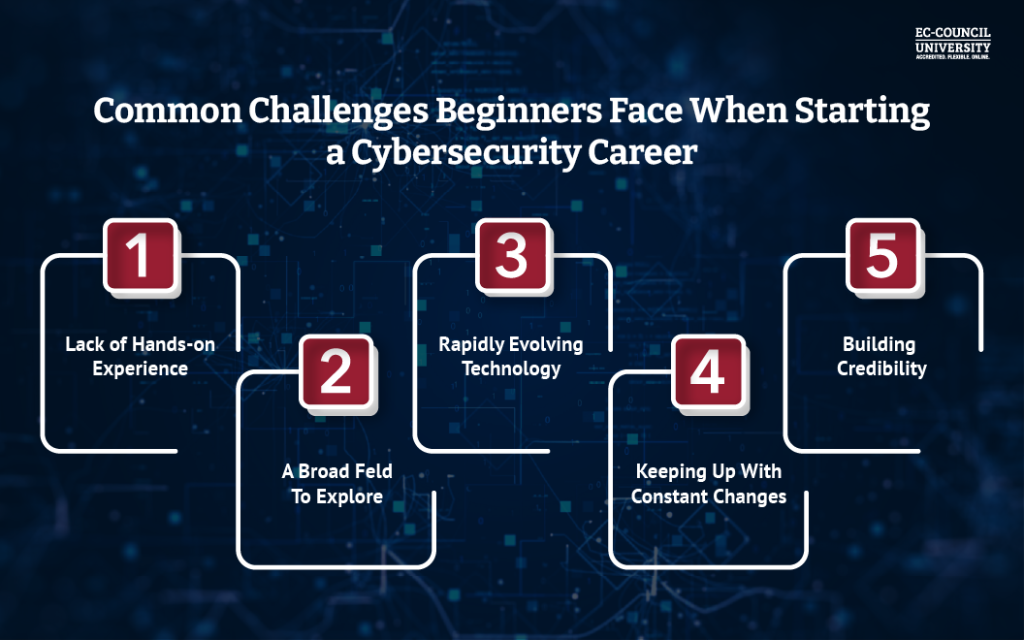
- Lack of Hands-on Experience: Many entry-level roles require practical skills that are not always acquired in traditional education.
- Overwhelming Range of Specializations: From ethical hacking to network security, incident management, choosing the right path can be confusing.
- Rapidly Evolving Technology: The fast-paced advancement of tech requires professionals to stay updated with the latest tools, trends, and cybersecurity strategies.
- Keeping Up with Constant Changes: Cyber threats evolve rapidly, requiring you to continuously learn and adapt.
- Certifications and credibility: Employers prioritize candidates with recognized credentials, such as degrees and certifications, which can be both costly and time-consuming.
What Experienced Cybersecurity Experts Recommend to Beginners
Employers and experienced cybersecurity professionals emphasize the criticality of building a strong foundation in cybersecurity and acquiring practical skills. All of this should be backed by credentials, such as degrees and certifications, to enhance employability. Beginners must start by gaining foundational-level knowledge and progressively develop advanced, specialized skills. This can be achieved through a structured learning approach.
Build Your Technical Foundation (Don’t Skip This)
Every strong cybersecurity career is built on solid fundamentals. This is where many beginners either succeed—or struggle.
Key foundational skills include:
- Basic computer systems (Windows, Linux, macOS)
- Networking concepts
- How the internet works
- Operating systems and processes
This is where network security fundamentals come into play. You’ll learn concepts like:
- TCP/IP
- Firewalls and routers
- VPNs
- Network segmentation
- Common attack vectors
Learn fundamentals early, ensuring you understand how systems work before learning how attackers break them.
Learn the Core Cybersecurity Concepts
Once you have acquired a foundation-level knowledge, it’s time to step into true cybersecurity territory.
Start exploring:
- Types of Threats, vulnerabilities, and risks
- Malware types (viruses, ransomware, spyware)
- Authentication and access control
- Encryption and data protection
- Security policies and best practices
This phase is crucial in any cybersecurity training for beginners, because it shifts your mindset from “user” to “defender”
Hands-On Practice Is Non-Negotiable
Cybersecurity is all about skills, and not just theory. For you to truly grow, you must:
- Practice in virtual labs
- Analyze simulated attacks
- Work with real tools used by professionals
- Learn how to think like both attackers and defenders
This is often the turning point where beginners realize that “I can actually do this.”
Choose the Right Cybersecurity Courses
Not all learning paths are created equal. What you really need is guided, academic, and industry-aligned education.
High-quality cybersecurity courses should offer:
- Clear learning outcomes
- Hands-on labs and simulations
- Real-world case studies
- Alignment with industry certifications
ECCU integrates academic coursework with practical learning, helping you connect theory to real-world cybersecurity scenarios that you may encounter in your professional work environment.
Consider Pursuing a Cybersecurity Degree
If you are serious about long-term growth, leadership roles, or working with top US organizations, earning a cybersecurity degree can be a game-changer.
A degree offers:
- Structured progression from beginner to advanced concepts
- Provides credibility of your knowledge and skills
- Exposure to multiple cybersecurity domains
- Prepares you for certifications and real-world roles
Certifications and Career Readiness
As you progress along your cybersecurity roadmap, certifications become an important milestone. The certificates validate and demonstrate your skills and credibility to employers, proving that you are job-ready.
While beginners shouldn’t rush to obtain certifications too early, certain institutions, such as EC-Council University’s online cybersecurity programs, naturally prepare students for industry-recognized credentials as they advance.
At this stage, you should also focus on:
- Resume building
- Understanding cybersecurity career pathways
- Staying current with evolving threats
- Possess technical know-hows of tools
Never Stop Learning (Cybersecurity Evolves Daily)
One of the most exciting and challenging aspects of cybersecurity is that it is constantly evolving.
New threats emerge daily. Technologies evolve. Regulations change.
Successful professionals commit to:
- Continuous learning
- Skill upgrades
- Staying informed on trends
- Lifelong curiosity
Why ECCU is the Best Place to Start Your Cybersecurity Career
EC-Council University is a globally recognized and accredited university offering a range of cybersecurity programs, from beginner-level courses to advanced, master’s programs in cybersecurity.
- Non-Degree Status Courses (NDS)
- Graduate Certificate Programs (GCP)
- Bachelor of Science in Cybersecurity (BSCS)
- Master of Science in Cybersecurity (MSCS)
- Master of Business Administration-Cybersecurity Specialization (MBA)
What truly stands out is the cybersecurity programs, which are tailored to combine foundational learning, practical skills building, hands-on experience, and integrated EC-Council certifications that focus on current industry requirements and employability needs.
ECCU instills a mindset of step-by-step progression and success early, helping beginners grow into adaptable, future-ready cybersecurity professionals. Through its structured program and learning approach, it establishes a guiding framework for a clear path to cybersecurity success.
So, whether you’re aiming for entry-level roles or planning a path toward advanced positions, ECCU provides the knowledge, credentials, and support to help you succeed in this dynamic field.
Check out this informative video to learn more about ECCU and its offerings:
Your Cybersecurity Journey Starts Now
If you’re feeling overwhelmed, take a breath—that’s normal. Every cybersecurity expert once asked the same questions you’re asking now. The key is to follow a clear, structured cybersecurity roadmap, build strong fundamentals, and choose the right learning environment.
With ECCU’s step-by-step approach, cybersecurity for beginners becomes not just manageable but exciting.
So whether you’re exploring what cybersecurity is, searching for the right cybersecurity training for beginners, or considering a full cybersecurity degree, remember this:
- The best time to start your cybersecurity journey was yesterday.
- The second-best time is today.
Ready to take the first step? Your future in cybersecurity is waiting!